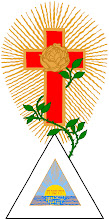
Fama Fraternitatis - 1614

Wiewohl wir nun wohl wissen, daß es umb ein ziemliches noch nicht an dem, da wieder unserm Verlangen oder auch anderer Hoffnung mit allgemeiner Reformation divini et humani, solle genug geschehen, ist es doch nicht unbillich, daß, ehe die Sonne auffgehet, sie zuvor ein HELL oder dunkel liecht in den Himmel bringt und unter dessen etliche wenige, die sich werden angeben, zusammen tretten, unsere Fraternitet mit der Zahl und Ansehen des gewünschten und von Fr.R.C. fürgeschriebenen Philosophischen Canons, einen glücklichen Anfang machen oder ja in unserer Schätz (die uns nimmermehr aufgehen können) mit uns in Demut und Liebe genießen die Mühsamkeit dieser Welt überzuckern und in den Wunderwerken Gottes nicht also blind umbgehen.

Vi vet dock att det enligt vår åstundan och andras förväntningar efter någon tid kommer en allmän reformation av både gudomliga och mänskliga ting. Ty innan solen går upp, upplyses himlen av
MORGONRODNADENS ljus. I väntan på denna reformation församlas några få som med sitt antal skall utöka vårt brödraskap, höja dess anseende och stärka dess förhoppningar och ge de av Fr.R.C. föreskrivna Filosofiska Canons en lycklig begynnelse. I all ödmjukhet och kärlek skall dessa nytillkomna tillsammans med oss dela våra skatter, som aldrig skall förgås, och så lindra denna världens möda och inte längre vandra ovetande om kunskapen om Guds underbara verk.

Howbeit we know after a time there will now be a general reformation, both of divine and humane things, according to our desire, and the expectation of others: for it is fitting, that before the rising of the Sun, there should appear and break forth AURORA, or some clearness, or divine light in the sky; and so in the mean time some few, which shall give their names, may joyn together, thereby to increase the number and respect of our Fraternity, and make a happy and wished for beginning of our Philosophical Canons, prescribed to us by our brother R.C. and be partakers with us of our treasures (which never can fail or be wasted) in all humility, and love to be eased of this worlds labor, and not walk so blindly in the knowledge of the wonderful works of God.

Definition

Det brittiska ordenssällskapet Hermetic Order of the Golden Dawn och den tyska Frimurarlogen L'Aurore Naissante, vilket grundades i London 1888 respektive Frankfurt-am-Main 1807, delade på samma hebreiska namn – Chevrah Zerach Bequr Aur, förevisat i gyllene gult vid bloggens huvud, vilket ordagrannt kan översättas till “Stigande Gryningsljusets Sällskap”. Denna tyska Rosenkorsiska Frimurarloge i Frankfurt, vilket måste anses vara det ursprungliga modertemplet till GOLDEN DAWN, kallade sig på tyska även Loge sur Aufgehenden Morgenröthe, vilket kan översättas till “Gryende Morgonrodnadens Loge”. Detta skiljer sig åt från den engelska seden att översätta orden Bequr Aur till “Golden Dawn” eller “Gyllene Gryningen”. Med anledning av Rosenkorstraditionens tyska ursprung är en mer korrekt översättning av Bequr Aur, genom franskans L'Aurore Naissante och tyskans Aufgehenden Morgenröthe, inget annat än GRYENDE MORGONRODNADEN. Denna hänvisning till ett stigande gryningsljus, morgonrodnad eller aurora är en klar hänvisning till den allmäna reformationen omnämnt i det ovan citerade stycket från Fama Fraternitatis. Denna blogg har dock valt att behålla den försvenskade anglo-saxiska termen GYLLENE GRYNINGEN för att denna, invand som den är, lättare associeras med den Rosenkorsiska tradition som här ämnas att framställas.

Licht, Leben, Liebe

torsdag 16 oktober 2008

The Rosicrucian kingdom of Poland

o

Throughout the history of European esotericism Poland is found to be one of the recurrent nations of prominence. It took a great part in the Alchemical revival of the 18th Century, together with Germany. Both the Gold- und Rosenkreutz Orden and the Asiatic Brethren had a strong presence and several circles throughout Poland. It even had a Rosicrucian Order of a uniquely Polish origin and limited to its territory called the Bon Pasteur (“The Good Shepherd”). In his important and groundbreaking work The Rose Cross and the age of reason Christopher MacIntosh devotes a whole chapter to Polish and Russian Rosicrucianism. I will return to this soon, but before I venture any deeper into prominent Polish Rosicrucians, let me direct your attention to the coat of arms of the Polish Nation (see image above). That beautiful emblem of the white eagle happens to be a recurring symbol of Alchemical sublimation and votality. Compare that heraldic symbol with the image below.

A striking similarity, don’t you think? I took that image from the work of Andreas Libavius referred to as Alchymia, printed in 1606. Another interesting feature of that document is the fact that it is surmounted by the letters “D.O.M.A.”, which links it with another important document called D.O.M.A. or Codex Rosae Crucis. The historian Rafał T. Prinke has traced that latter document to the German province called Silesia and the year of 1650. Nowadays Silesia belongs to Poland and hence has attached the Polish name of Śłąsk. The capital city of this region is called Breslau in German and Wrocław in Polish. Now this beautiful city holds one of the most prominent Masonic Library’s in the world, maintained by the University Library of Wrocław. According to Rafał L. Prinke’s private research the original manuscript of the D.O.M.A. resides in this library.

According to Prinkle the important Rosicrucian manifesto of Die wahrhafte und volkommene Bereitung des philosophischen Steins der Bruederschafft aus dem Orden des Gulden und Rosen Kreutzes by Sincerus Renatus (a.k.a Samuel Richter) was in fact published in Wrocław, Silesia, in the year of 1710. It heralded the Gold- und Rosenkreutz Orden and the later reformation of 1777. Samuel Richter was according to Christopher MacIntosh of Silesian origin, as was probably his group according to Prinke, the same group which later published the D.O.M.A., of which several plates later were published in the Geheime Figuren (Altona 1785-88) by the auspices of Gold- und Rosenkreutz Orden.

As a side note, Prinke in his research also found a copy of Andreas Libavius Alchymia in the Poznan University Library, bound together with an early letter to the Rosicrucian Brotherhood which was published together with the Fama and Confessio entitled Sendschreiben mit kurtzern Philosophischen Discurs an die Gottweise Fraternitet des Loblichen Ordens des Rosen Creutzes. As this document allegedly were printed in 1606 it is interesting to note that the letters D.O.M.A. are attached to a document even preceding the original manifestos, and Sincerus Renatus “manifesto” by a century, hence his group were previously contemporary with the group of Johann Valentin Andreae, or else these letters have a significance to Rosicrucianism in general and are not restricted to Sincerus Renatus’ group. Personally I believe that even if there existed different and autonomous Rosicrucian groups or circles they all belonged to a loosely knit fraternal network bound together through a common set of laws. I will return to these laws shortly, but let us first revert to the subject matter of Polish Rosicrucianism.

While Silesia historically is a German province it has always bordered on the Polish territory and been an area of cultural cross pollonization. According to Prinke it is “usually overlooked that the only modern author quoted by name in the D.O.M.A. is the great Polish alchemist Michael Sendivogius”. So alchemy has always had as high prominence in Poland as it has had in Germany. One can easily regard the two countries as “twins” and interdependent in the context of Rosicrucianism and esotericism, not to mention the Rosicrucian form of Qabalah which actually had its origin in Polish Hasidism. But, if we are to believe Rafał T. Prinke, Poland may have been the fertile ground for the emergence of Rosicrucianism as well.

Henricus Neuhusius in his Pia et utilissima admonitio de Fratribus Rosae Crucis (published in Danzig 1618) maintained that Rosicrucians were Socinians, i.e. belonging to a Polish Unitarian reformative branch of Christianity, aslo reffered to as the Polish Brethren, adhering to the theological teaching of the Alexandrian priest Arius (c. AD 250-336). According to Prinke the earliest reference to Rosicrucians - not only in Polish literature but perhaps in the whole world - comes from a poem Theatrum diabolorum by Jan Borawski, a Polish Protestant pastor from Brodnica/Strassburg in Prussia, with some tentative evidence that it was published for the first time in 1607, i.e. antedating the Rosicrucian manifestos. The relevant fragment of the poem is:

Te solum fratrum roseae crucis expedit ordo
Anglicus ille nocens, sudor et atra lues,
Gorgonea illuvies, gangraena, corizque mundi,
Deformatores dixeris orbis eos.

Prinkle, which adheres to Frances Yates’ theory of John Dee as the true originator of the Rosicrucian movement, has also suggested the above mentioned Michael Sendivogius (1566-1636) to be the missing and needed “paracelsian” link between Dee and the Rosicrucian manifestos in the 17th Century. He even suggests Sendivougius to be the true model for the mythical Frater C.R.C., i.e. for Christian Rosenkreutz himself! Well, this story isn’t at all that far fetching as we know for certain that Sendivougius was acquainted with John Dee and Edward Kelly. We also know that Dee and Kelly travelled extensively in Poland during the most productive years of their collaboration; i.e. Poland has a place of prominence also as regards the genesis of “Enochian Magic”, congenial to the Golden Dawn tradition.

Michael Sendivogius

Michael Sendivogius, or Michał Sędziwój as he was known in his native country, is renowned for being one of the very few alchemists who possessed the true secrets the Great Work, i.e. the production of the Philosophers Stone. He also made important contribution to the later scientific discovery of the life-giving qualities of air (i.e. oxygen). He is known to have made several “projections” and transmuted gold from quicksilver, even in the presence of the Austrian Emperor Rudolf II. He also made alchemical operations within the court of the Polish King Sigismund III Vasa (1566-1632), who also was the King of Sweden, himself an enthusiastic alchemist who often took part in Sendivogius' experiments. Their collaboration started in 1606 after a successful healing of the King by the white and red powders. In Kraków's Wawel castle, the chamber where these experiments were performed is still intact.

In 1604 he published his most important work Novum Lumen Chymicum (“A New Light of Alchymie”), also known as De Lapide Philosophorum Tractatus duodecim (“Twelve Treatises on the Philosophers’ Stone”), which were written in alchemical code only to be understood by other alchemists. He also published various scientific and philosophical material which were repeatedly translated and widely read among such worthies as Isaac Newton, also a renowned alchemist.

Michael Sendivogius lived a quite anonymous life and all his books were published incognito, as he says in his De Lapide Philosophorum: “If you ask who I am: I am Cosmopolita” and “I doubt not that there are many persons of good conduct and clear conscience who possess this great gift of God in secret. I pray and conjure them that they should preserve even the silence of Harpocrates”. Still he became somewhat of a legend during his lifetime and was for example admired among the Tübingen university intellectuals (the city wherein the circle of Johann Valentin Andreae were active).

Sendivogius started his higher education at the Jagiellonian University in Crakow in about 1582 where hermetic teachings and Paracelus were held in high esteem and whose protector was Albrecht Laski (1536-1603), the one responsible for bringing Dee and Kelly to Poland. Laski himself was interested in hermeticism and alchemy according to Prinke. Dee and Kelly were both in Crakow and in Prauge at the same time as Sendivogius, so according to Prinke the latter was in the midst of important events, perhaps even being the companion to Dee and Kelly on his way to Prague. While in Bohemia Sendivogius collaborated with the great Czech alchemist Bavor Rodovsky, whose protector and host Villem of Rozemberk also hosted Dee and Kelly in Trebona. So they all spend some time together in Bohemia.

Later, being a part of the court of the emperor Rudolph II Sendivogius traveled extensively around Europe, combining diplomatic duties with alchemical studies. In Constantinople, Prinke states, he was taught the secrets of alchemy by the Greek patriarch and there is also the story about his “praeceptor” from Egypt, “all of which is very strongly reminiscent of the journey fo Father C.R.C. to Damascus [i.e. Damcar] and Fez”. Sendivogius also made friends with Johann Tolde, which edited and probably wrote the works ascribed to Basilius Valentinus, a true icon in the eyes of Rosicrucians expounding the secrets of the dry path of Antimony.

According to Prinke in 1595 Sendivogius also met Duke Frederick of Wurttemberg, a personality which is associated with the early beginnings of Rosicrucianism as his court “was a centre of alchemical and occult activities, with Simon Studion and Johann Valentin Andreae as its most notable Rosicrucian figures”. After his return to Prague 1595 and during his travels to Poland after the turn of the Century Sendivogius made himself a reputation of healing and performances of alchemical transmutations. In 1605 he was invited again by the Duke of Wurttemberg, staying there for some years. He also met and knew the Bohemian Rosicrucian Johan Amos Comenius. This clearly says a lot about the reputation of Sendivogius, and of his Rosicrucian connections. But according to Prinke he may have had a hand in or influced the Rosicrucian manifestos. In the preface to his Treatise on Sulphur (published in 1613) Sendivogius says:

The times are at hand when many secrets of Nature will be revealed to men. The Fourth or Northern Monarchy is about to be established; a happy age is coming; enlightenment, the Mother of Sciences, will soon appear; a brighter Sun than in any of the preceding three Monarchies will rise and reveal more hidden secrets. This Monarchy (as the ancients foretold) God's Omnipotence will found by the hand of a prince enriched with all virtues who, it is said, has already appeared in this present age. In this our northern region we see a prince of uncommon wisdom and valour, whom no king can surpass in victories or in love of men and God.

In this Northern coming polar Monarchy (as the Psalmist says) mercy and truth will meet together, peace and justice will kiss each other, truth will spring up from the ground, and righteousness will look down from heaven. There will be one Shepherd and one fold, and knowledge will be the common property of all without envy. I look forward to all this with longing.

These words are quite reminiscent of the “Allgemeine und General Reformation” spoken of in Fama Fraternitatis, published one year later. As Prinke notes, of “special importance is the use of the very term ‘Fourth Monarchy’, so important in the Rosicrucian context. The well known fragment from the Fama says ‘In Politia we acknowledge the Roman Empire and Quartam Monarchiam for our Christian head; albeit we known what alterations be at hand, and would fain impart the same with all our hearts to other godly learned men’. The mention of a prince who will establish the new Monarchy confirms the hypothesis of Frances Yates in a quite surprising way, while the words about ‘a brighter sun’ that will rise are clearly the same theme as the statement in the Fama saying that ‘before the rising of the sun there should appear and break forth Aurora, or some clearness, or divine light in the sky’. This Aurora is clearly Aurora Borealis, announcing the advent of the Northern Monarchy as foretold by Heliocantharus Borealis”.

Another “evidence” for the Sendivogius connections with the Rosicrucian manifestos, according to Prinke, is the fact that the Consideratio Brevis of Philip a Gabella, published together with the first edition of the Confessio Fraternitatis at Cassel in 1615, not only was based on Dee's Monas hieroglyphica but also on Sendivogius’ De Lapide Philosophorum. While the parts taken from Dee’s Monas hieroglyphica are verbatim quotations, according to Prinke numerous statements from Sendivogius book are “either taken directly from it or summarising its fragments, or saying the same things in different words”. But then Prinke wisely adds, the question arises “if he was the real moving spirit behind the Rosicrucian Manifestos or just the figure of a master that the first Rosicrucians admired and took as a model for Christian Rosenkreutz? This question will have to remain unanswered for the time being though we may examine the former possibility as well”.

Prinke dares however to speculate if it wasn’t Sendivogius who penned the Brevis as the probable unknown head of the Novo Cabalae Philosophorum Incognuorum dignissimo Sodali or “Secret Society of Unknown Philosophers of Cabala”, referred to in his The Philosophical Letters written in 1616. Perhaps, or even probably, this is a reference to the Rosicrucian Brotherhood. This society has also been associated with Louis Claude de Saint Martin (1743-1803) as “The Order of The Unknown Philosophers”, which according to one tradition descended from Les Freres d’Orient, an initiatic order supposedly created in 1090 in Constantinople under the patronage of The Emperor Alexis Comenius, reputedly including Heinrich Khunrath, Alexander Sethon, Rudolph Salzmann, Jacob Boheme, and our hero Michael Sedivogious as members. If this is a true account, there obviously exists a connection between the Martinist and Rosicrucian traditions, at least this has often been stressed by the Martinists themselves. Personally I have no personal preference in this matter, even though I can’t help being a little bit skeptical towards the Martinist-Rosicrucian link (to me it sounds more like a later invention), but I must confess that I find it interesting to note that Saint Martin in fact referred to himself as the “unknown philosopher”. Perhaps it’s most fair to regard Rosicrucianism, Martinism and Freemasonry as “sister” traditions, being branches of the same trunk of the Western Mystery Tradition; not identical but akin.

But let’s not digress from the main subject of this essay and instead at last turn our attention to the Polish contributions on the later alchemical revival of the 18th Century, yet to find another Royalty deeply involved within this current. According to Christopher MacIntosh the last King of Poland, Stanislas Augustus Poniatowski (1732-1798), were a Freemason and a Rosicrucian - referred to as a Chevalier Rose-Croix of the 21st degree. He has been regarded by historians as a enlightened despot, a Polish equivalent of Fredrick the Great of Prussia, Josheph II of Austria, or Gustav III of Sweden, being renown for accomplishing much in the realm of culture, fine arts and education. But he is also a controversial figure as he was accused of doing away with the liberties of the Polish nobility (as did the Swedish Freemasonic and Rosicrucian King Gustav III), even desiring the downfall of the Roman Catholic Church (in a good Rosicrucian fashion), and also being accused of weakness, subservience and treason.

King Stanislas Augustus Poniatowski

As a future King Poniatowski was in fact trained and educated by two alchemists and Rosicrucians, Lucas de Toux de Salverte and the Polish Count August Moszynski. The latter probably were the head of the Polish branch of the Gold- und Rosenkreuz. With the financial support of the King, they both set up an alchemical laboratory in the Ujazdowski palace, even causing great damage to the castle when a accidental fire broke up during an alchemical experiment. According to MacIntosh Moszynski in 1768 wrote “a manuscript treatrise addressed to the King entitled Réflexions sur la science hermétique”. The king himself wrote several papers on the subject of alchemy. During his reign in the mid-1770s the membership of the Gold- und Rosenkreutz amassed, including nobility, officers and other dignitaries.

The Rosicrucian system of Bon Pasteur was supposedly founded in 1750 by Toux de Salverte, i.e. preceding the Gold- und Rosenkreutz Order of Herman Fictuld even if it shared many features with the latter. It was probably to this Order that the Polish King were initiated, as it has a degree with the title of “Chevalier Rose-Croix”. Like the Gold- und Rosenkreutz it started off from the Scottish Master Degree, i.e. from the 5th degree and onwards to the 12th. MacIntosh notes that both the Bon Pasteur and the Gold- und Rosenkretuz shared “a pietistic type of Christianity with a Gnostic, dualistic colouring”. Alchemical symbolism were prominent within both systems. They even shared many common rules, which had their origins in the document of Sincerus Renatus and the Rosicrucian group around the document D.O.M.A. That in turn were strikingly similar, according to MacIntosh, to another document called the Testamentum der Fraternität Roseae et Aureae Crucis. Thus MacIntosh concludes that Bon Pasteur can “be seen as a Polish offshoot of the same stream to which the Gold- und Rosenkreutz belonged”.

So, from a cultural and esoteric point of view, Poland is to be regarded as the backyard of Germany, or perhaps as the younger brother of the Teutonic family. Remember that Prussia (the descendent of the Teutonic Order) once comprised the majority of the territory today known as Poland, and that many noble Prussian families bears strikingly polish-sounding family names. The Poles can be compared to the Chezchs, like an adopted sibling to the Germanic people. No surprise then that the German alchemical and Rosicrucian revival during the 18th Century was prominant in Poland.

This, as regards Rosicrucianism. But if we look at the Qabalah, which from the very start of Rosicrucianism has held a prominent place within the R+C, we find Poland as the main area of origin. I have tried to extrapolate this origin in my two previous essays on the origin of the Hermetic Qabalah of the Golden Dawn here and there. I recommend reading these before proceeding any further to get the full perspective of my proposition. It also becomes quite clear, in reading the history of Jewish mysticism in Europe, that there has in fact over time developed two different branches or centres of Qabalah (or Kabbalah), the Spanish and Polish traditions. Actually it was Israel Regardie who brought my attention to this fact when he pointed out the differences in transliteration between the Spaniards and the Poles; the Hermetic Qabalah are based on the Polish tradition of transliteration.

Granted, the Hermetic revival and the development of the “Christian Kabbalah” during the renaissance came from Italy, as everything else in those times. But if we are talking about the Lurianic Qabalah, which took a prominent place in the Rosicrucian current after the 1777 general reformation, we have to search for the origins of that influence in Poland, and the special branch of the Sabbatheian tradition called Frankist Qabalah. It is this latter brand which took prominence within the German Rosicrucian revival during the 18th Century, especially so after the emergence of the Fratres Lucis, or Asiatic Brethren, which consummated the full integration between Hermeticism and Qabalah. Through the Frankfurt-am-Main “Jewish” Lodge of L'Aurore Naissante (or “the Nascent Dawn”), founded in 1807, this special hybrid of the Hermetic Qabalah found its way into the Hermetic Order of the Golden Dawn.

So, in conclusion, if we as Golden Dawn initiates have any interests in the roots of our beloved tradition (as we should have to gain a full understanding of it and the context in which it was created) we must turn our eyes not only to Germany but to Poland as well.

So, lets complete a full circle and return to the coat of arms - the white eagle. The image at the top is a representation of the national emblem of Poland as it was redesigned in 1927. But this emblem strikingly resembles the coat of arms from the 16th Century. It was probably in vogue to draw heraldic eagles in this fashion, even in alchemical manuscripts. But it is fascinating that this obvious alchemical design of the eagle has survived until now. But of course, the white eagle of Poland has striking similarities with the black eagle of Prussia and Germany, stemming from the Teutonic Order, which bears the same general features.

This of course only confirms the close ties between these two countries. However, limiting it to alchemical symbolism, the black eagle (to my knowledge) in not as prominent or common in classical alchemical manuscripts as is the white eagle. There exists a black bird in alchemy - the black raven - but the black eagle is quite rare. As eagle symbolism in alchemy oftentimes depicts sublimation or distillation, it fittingly wears the colour of purity - whiteness.

All this confirms my argumentative point of view were I look upon Poland as one of the most prominent centres of esotericism in 17th and 18th Century Europe, in par with Germany, Austria and Czechia. Furthermore, in the union between the German Rosicrucianism and Polish Qabalah we suddenly must view Poland as an indispensable part of the heritage of Hermetic Qabalah and the Golden Dawn.

S∴R∴

onsdag 15 oktober 2008

Jungfru Maria - Aima Elohim

o
Se på den vacka ikonen ovan. Man kan å ena sidan beundra dess enkelhet och lite grova utformning, samtidigt som den är oerhört suggestiv och med faschinationen som redskap drar in betraktaren till sig. Den är fylld med symbolik. För er som inte redan har förstått detta så skall ikonen föreställa Jungfru Maria. Det är dock inte Maria människan utan snarare Den Heliga Jungfrun såsom Guds Moder, eller den gudomligt feminina principen. I samband med detta vill jag återkoppla och hänvisa till min tidigare essä om den frankistiska qabalah, där jag ganska tydligt redogör för madonnadyrkan bland en viss sekt - den frankistiska - inom den judiska mystiken, vilket sedermera influerade Golden Dawn-traditionen, genom förmedlingen av de Asiatiska Bröderna.

Ikonen härstammar från min moder, vilket sedan några veckor tillbaka gick över till den andra sidan (må hennes själ vila i frid). Jag fick med mig den i helgen från min moders dödsbo, som ett minne av henne. Att den kommer från min moder ger det hela en extra laddning, inte bara för att hon betydde mycket för mig utan för att hon för mig såsom ett barn var laddad med en mytisk gestalt; för mig var hon min Gudomliga Moder - Gudinnan som hade skapat mig. Ikonen, som är en symbol för vår allas Gudomliga Moder, sluter symboliskt cirkeln mellan det makrokosmiska (världen) och det mikrokosmiska (mig).

Denna lilla tavla har hängt i mitt barndomshem sedan så långt jag kan minnas. Jag erinrar mig att den, av alla ikoner hemma, faschinerade mig mest - utan att jag riktigt visste varför. Tavlan själv är köpt i Polen, landet där madonnakulten inom den katolska världen är som starkast och mest utbredd. Det var nära att jag missade ikonen när vi gick igenom min moders kvarlåtandeskap och jag hade flera gånger tittat igenom de olika ikonerna utan att ha fastnat för någon. När jag tittade för tredje gången så bestämde jag mig för att i alla fall ta med mig denna ikon som stog ut som unik bland alla de andra och uppenbarligen hade en mystisk dragningskraft på mig. Väl hemma började jag inse hur djupt laddat med esoterisk symbolik den faktiskt är. Låt mig snart förklara hur. Men först, för att göra det extra tydligt, vill jag jämföra ikonen med följande bild (eller detalj) hämtad från diagrammet i Golden Dawns Practicusgrad (3°=8°) kallat Edens lustgård innan syndafallet.


Jämför noggrannt båda illustrationerna. Se månskäran vid fötterna på diagrammet ovan och längst ner på ikonen (den senare är lätt att förbise; det var först när jag tittade på den hemma som jag såg den). Observera även Solens symbol hos dem båda - förvisso är solen vid huvudet såsom en gloria i ikonen medan figuren i illustrationen ovan är "klädd med Solen". Men glorian runt Maria är inte som den traditionellt brukar illustreras i de kristna ikonerna - det har formen som en sols strålar (solskivan skymtar dessutom bakom huvudet). Kronan på figuren ovan är dessutom klädd med en strålande krona, vilket förstärker eller bekräftar symboliken hos ikonen över Maria. Även Maria är krönt med en gyllene konungslik krona, vilket är ganska vanligt inom den katolska ikonografin.

Jag insåg ganska så snart att båda dessa bilder uttryckte samma sak, eller att den kristna ikonen var en variant på denna esoteriska Golden Dawn-symbol. Det kanske inte framgår av bilden men figuren innanför regnbågscirkeln är en kvinna, inte vilken kvinna om helst utan det gudomligt feminina - inom Qabalah kallat Aima Elohim.

Aima Elohim kan översättas till "Den Gudomliga Modern", eller mera fritt tolkat till "Guds Moder". Hon är i detta diagram en representation eller en syntes av Den Gudomliga Triaden - Kether, Chokmah och Binah. Men hon hänvisas i synnerhet till Binan, vars Qabalisktiska titel bl.a. är Aima eller Ama - "Moder". Såsom Ama är hon Modern i sin jungfruliga form, innan befruktelsen, men befruktad av den Gudomliga Fadern - Abba (Chokmah) - blir hon den havande modern Aima. Här vill jag hänvisa till ytterligare en illustration - Tarottrumfen Nr. 4 eller Kejsarinnan. Den version som jag visar här nedan är den som utformades av den framstående Golden Dawn Adepten Paul Foster Case (och av mig färglagt).

©Tomas Stacewicz

Här har vi återigen en kvinna med månen vid sina fötter och krönt av en krona som hänvisar till de celesta regionerna, i det här fallet prydd med 12 stjärnor. Observera nu återigen ikonen på Jungfru Maria - se att det mellan hennes solstrålar finns stjärnor. Dessa erinrar om de 12 stjärnorna vid Kejsarinnans hjässa. Dessa 12 är även en hänvisning till de 12 solstrålarna hos Aima Elohim i diagrammet Edens Lustgård. Enligt Practicusritualen sägs det om henne i följande termer:
AIMA ELOHIM, Den Gudomliga Modern - Apokalypsens Kvinna (Kap. 12) klädd med SOLEN, med MÅNEN under sina fötter, och Kronan med Tolv Stjärnor på hennes huvud.
Detta förenar Aima Elohim med Kejsarinnan, men då illustrationen i diagrammet Edens Lustgård förevisar Ama - den junfruliga Modern - så illustrerar Kejsarinnan Aima, den pregnanta eller havande modern. Observera att jag har främhävt hennes underkropp för att associera till havandeskap. Låt oss nu läsa vad 12:e Kapitlet i Johannes Uppenbarelse har att säga om Apokalypsens Kvinna:
Och ett stort tecken visade sig i himmelen: där syntes en kvinna, som hade solen till klädnad och månen under sina fötter, och en krans av tolv stjärnor på sitt huvud. Hon var havande och ropade i barnsnöd och födslovånda. Ännu ett tecken visade sig i himmelen: där syntes en stor röd drake, som hade sju huvuden och tio horn, och på sina huvuden sju kronor. Och hans stjärt drog med sig tredjedelen av himmelens stjärnor och kastade dem ned på jorden. Och draken stod framför kvinnan som skulle föda, ty han ville uppsluka hennes barn, när hon hade fött det. Och hon födde ett gossebarn, som en gång skall styra alla folk med järnspira. Men hennes barn blev uppryckt till Gud och till hans tron. (Upp. 12: 1-5)
Se i samband med detta det diagram som följer på det ovan refererade, det som hänförs till Filosofusgraden (4°=7°) och kallas Edens lustgård efter syndafallet:
I detta diagram ser man tydligt Den Gudomliga Triaden avbildad och Aima Elohim som hänförd till Binah. Man ser även tydligt den Röda Draken, symbolen för ormkraften - kundalini. Sonen med "järnspira" är naturligtvis en hänvisning till Kristus. Inom Den Kristna Qabalah är han synonym med Adam Kadmon, den arketyptiske människan - sinnebilden för den återställda människan som åter skall taga Lustgården i besittning och härska från sin nya uppstiga ställning. Denne Adam kan ses på diagrammet Edens lustgård efter syndafallet i den manliga figuren mitt på Korset omsvept av Draken. Det är det "naturliga" tillståndet som han (eller vi) befinner oss idag, såsom "Jorden Barn". Såsom den återställde Adam, såsom en Kristus - krönt och smord såsom Konung - illustreras människan i följande diagram taget från Adeptus Minorgraden (5°=6°).


Observera att drakens käftar har släppt greppet om de lägre Sefiroth. Allt detta utgör en sinnebild över den segrande Adepten, vilket har blivit ett med Kristus och tagit kontrollen över sin begärsnatur (utan att för den skull förneka den).
Detta är symbolen för den Apokalyptiska Kvinnans gossebarn, "som en gång skall styra alla folk med järnspira". Men det är hennes barn efter att han har blivit uppryckt till Gud och till hans tron. För att avslutningsvis återknyta till ikonen över Jungfru Maria så anser jag henne vara identisk med Den Apokalyptiska Kvinnan i Johannes Uppenbarelse. Det ser man tydligt i symboliken, med Månen vid hennes fötter och klädd av Solen, och krönt med Kronan av 12 stjärnor. Symbolen över Solen och Kronan är här förtätad i en och samma symbol, och förvisso består den ej av varken 12 strålar eller 12 stjärnor. Men det är tillräckligt nära för att ej kunna förbises.

Hittills har jag uppehållit mig vid det makrokosmiska (eller kollektiva - yttre) perspektivet. I mikrokosmos (eller individen - det inre) är Den Gudomliga Modern - Apokalyptiska Kvinnan - representanten för människans högsta och odödliga själ kallad Neshemah på hebreiska. Det är med denna aspekt av sig själv som Magikern eller Alkemisten - Mystikern - söker förening med i sitt Stora Verk. I ett psykologiskt perspektiv är Aima motsvarigheten till Carl Gustav Jungs Anima, den princip som tjänar som förbindelselänken mellan jaget och det omedvetna. I ett esoteriskt perspektiv tjänar Neshemah - vilket är en feminin princip - att utgöra förbindelselänken mellan individens högre eller odödliga själ (Det Högre Jaget) och Gud (Det Enda Jaget). På så vis har hon en viss relation med den judiska föreställningen om Shekinah, eller Guds Brud och närvaro i världen. Men då börjar vi närma oss föreställningen om Malkah - Drottningen - Den Lägre Modern, vilket är en reflektion av Den Högre Modern Aima. Men då talar vi mera om Maria människan. Symboliken vi hittills har talat om angår mer Maria såsom den Gudomliga Modern, men de båda är varandras motsvarigheter fast på olika plan.

Jag vill också göra läsaren observant på hur Jungru Maria håller sina händer. Detta, att hålla den ena handen över den andra och med handflatorna mot bröstet är mycket snarlikt hur man tecknar 5°=6° Gradens Tecken (även kallat L.V.X. Tecknen). Det är mera specifikt den avslutande ställningen i en längre serie - kallad Osiris Uppstånden - vilket korresponderas med "X" i L.V.X.; korset. Återigen är det en hänvisning till den återställda och på tronen satta Kristus.

Nå, är allt detta en slump? Troligtvis inte (inte i min värld i alla fall; vari det ej existerar någon "slump"). Och om inte vad är det då ett uttryck för? Kan det vara en intuition ifråga hos konstnären - hantverkaren? Har han tappat ur den ocean som Jung kallar för det "kollektiva omedvetna"; har han kommit i förbindelse med samma arketyp som en gång i tiden Golden Dawn-traditionens skapare? Eller kan det vara så att det är ett spår av den förbindelse som finns mellan den Frankistiska Qabalah och den typiskt Polska formen av kristen ikonografi och madonnakult? Kan
Yakov Leib Frank ha blivit inspirerad så pass mycket av den katolska traditionen och dess specifika polska madonnekult att den till slut fördes vidare till Golden Dawn? Eller kan det vara så att Franks sekt påverkade kulten i Częstochowa?

Det är svåra frågor som troligtvis ej går att besvara idag. Faschinerande är det dock hur allt hänger ihop, mellan ett diagram som jag utsattes för för första gången under senare hälften av 90-talet och dessförinnan i mitt föräldrarhem, och nu återigen efter min gudomliga moders himmelsfärd på en hedersplats i min egen lägenhet. För mig personligen är det i alla fall hisnande och fyllt med djupare mening.

S.R.

lördag 11 oktober 2008

Rosenkorsaren Johan Amos Comenius

o
Rosenkorstraditionen har i sina ursprungliga stadier i huvudsak varit koncentrerat till de centraleuropeiska tysktalande länderna. Men dess influenser nådde snart även tyskarnas grannfolk både i öst, väst, söder och i norr. Idag skall jag lägga fokus på en viss tjeckisk Rosenkorsisk Adept vid namn Johan Amos Comenius, eller Jan Ámos Komenský som han hette på sitt eget modersmål tjeckiska (och jag står i tacksamhetsskuld till Ian Cowburn för att ha gjort mig uppmärksam på Comenius kopplingar till R+C).

Comenius föddes i Mähren 1592 och dog 1670 i Amsterdam. Han är mest känd för eftervärlden som en av pedagogikens pionjärer med verk som Orbis Pictus, Didactia Magna och Janua Linguarum Reserata, vilket sägs ha inspirerat sådana storheter som Jean-Jacques Rousseau.

Johan Comenius var född i en särskild protestantisk sekt under namnet Moraviska Brödraskapet, vilket även hjälpte honom att påbörja sina studier i latin. Brödraskapet går under flera namn, bl.a. Bömiska Bröderna, Tjeckiska Brödraskapet, Jednota bratrská (på tjeckiska), Unitas Fratrum (latin för “brödernas enhet”), samt Moraviska Kyrkan. Brödraskapet utgjorde en del i den mysticistiska ådran inom den reformerade kyrkan, på samma sätt som de Lutheranska pietisterna var det i de tysktalande länderna, men föregick den senare med ett drygt decennium. Dess stora inspiration och grundare var den Böhmiske reformatorn Jan Hus (1371-1415), och dess symbol den över lammet och den korsprydda flaggan (se illustration).

Inom Johan Comenius bekantskapskrets kan man bl.a. finna svensken Johan Skytte (1577-1645), och under åren 1641-48 bostatte han sig t.o.m. i Sverige, där han passade på att sprida sina reformpedagogiska idéer i vårt land. Comenius blev dock tvungen att lämna Sverige då han blev utnämnd till biskop över Brödraskapets kyrka.
o
Men framför allt - och i synnerhet av instresse
för oss - finns det kopplingar mellan Comenius och Johann Valentin Andreae (1586-1654), författaren av de Rosenkorsiska Manifesten Fama et Confessio Fraternitatis och Christian Rosenkreutz Alkemistiska Bröllop. Comenius påbörjade sina universitetsstudier i Heidelberg år 1613, samma tid som Andreae befann sig där och bara något år innan de första Rosenkoriska manifesten publicerades. Francis Yates, som menar att Andreae och Comenius hade mycket gemensamt, gör följande jämförelse dem emellan i sin Rosicrucian Enlightment:
Båda var gudsfruktiga, reformerade präster; båda var intresserade av de nya intellektuella rörelserna som de överförde till sin infödda fromhet, den tyska Lutheranska traditionen [Andreae] i det ena fallet, och i det andra den Hussitska traditionen [Comenius]. Båda genomlevde samma fruktansvärda period [30-åriga kriget] och var tvugna att arbeta på så gott de kunde genom krig och förföljelser. (Min översättning.)
Hon anser vidare att det är troligt att Comenius blev influerad av den Rosenkorsiska filosofin som cirkulerade i Tyskland innan han 1614 återvände till Tjeckien. Eller - spekulerar Yates - kanske det var så att Comenius och läran hos de Moldaviska Bröderna inspirerade Andreae och hans Rosenkorsiska cirkel i Thübingen, ett antagande som jag dock anser vara föga troligt. Det må vara hur som helst med den saken, men att det finns kopplingar mellan dessa grupper anses av flera historiker vara plausibelt. Comenius anses bl.a. även ha varit influerad av den engelske Rosenkorsaren Francis Bacon (1561-1626).

Det är intressant i detta sammanhang att Johan Comenius daterar Fama Fraternitatis till 1612, två år innan dess officiella publicering i Tyskland. Detta, tycker jag, är ett bevis på att Comenius hade tillgång till ett exemplar av de privat tryckta utgåvorna som cirkulerade ett par år innan den offentilga utgivningen. Endast de som hade ett nära förhållande till gruppen kring Johann Valentin Andreae kunde ha tillgång till den tidiga privata utgåvan.

Under de nästföljande åren, i kölvattnet på de Rosenkorsiska Manifesten 1614-1616, samlade Comenius material till en encyklopedi och utvecklade sin variant av den pansofiska filosofin. Denna filosofi, vilket har sin grund i den platonsk-hermetiske filosofen Francesco
Patrizi av Cherso (1529-1597), uttrycker doktrinen om den universella harmonin och förbindelsen mellan människans inre värld och naturens yttre - en makro-mikrokosmisk filosofi. Även Robert Fludd (1574-1637) kallade sin filosofi pansofisk och kopplade denna till Rosenkorsläran. Det är av denna anledning tämligen tydligt hur mycket influerad Comenius var av den Rosenkorsiska strömningen. I sin Ljusets Väg från 1641 (publicerad 1668) skriver han följande:
De föregående tidernas uppfinningar, navigation och tryckning, har öppnat upp en väg för ljusets utspridande. Vi kan förvänta oss att vi står vid tröskeln till ännu större framsteg. De “universella böckerna” [Comenius böcker om pedagogik] kommer att göra det möjligt för alla att lära sig och ta del i framstegen. Pansofins bok kommer att fullbordas. Den universalla visdomens skolor som förespråkades av [Francis] Bacon kommer att grundas. Och den universella visdomens profeter i alla länder måste vara tillgängliga för varandra. “För även om det är sant att världen ännu inte fullt ut har saknat gemenskap, har ehuru denna form av gemenskap som den har åtnjutit saknat en universalitet.” Därför är det önskvärt att “den allmänna lyckans och välfärdens ombud” skall vara många. De måste ledas av någon ordning, “så att var och en av dem må veta vad han måste göra, och för vem och när och med vilket bistånd, och må gå tillväga med sitt verk på ett sådant sätt som är fördelaktigt för allmänheten.” Där måste finnas ett Kollegium, eller ett heligt sällskap, vigt åt mänsklighetens allmänna välfärd, vilket hålls samman av vissa lagar och regler. För att gagna ljusets utspridande måste där finnas ett universellt språk som alla kan förstå. De lärda av denna nya ordning kommer att ägna sig åt detta problem. Så kommer Evangeliets ljus, så väl som vetandets ljus, att spridas över hela världen. (Min översättning.)
Johan Comenius var även en frekvent och uppskattad gäst i hovet hos den Böhmiske “vinterkonungen” Fredrik I. Denne Fredrik I var gift med Elizabeth Stuart, dotter till konung Jakob I av England. Comenius beundrade den Böhmiske konungen och såg hos honom en gudomlig uppgift i den kommande reformationen av världen. Samtidigt rasade det våldsamma 30-åriga kriget mellan den protestantiska och katolska världen. I samband med Fredricks nederlag år 1620 blev Böhmen ockuperat av den spanska katolska armén och de Moldaviska Bröderna blev förbjudna. Comenius förutsåg dock i en vision hur Fredrik I skulle återbördas till sin tron över Böhmen.

År 1628 fick Comenius dock fly till Polen där han bl.a.
gav ut Världens Labyrint år 1631 (vilket han hade skrivit redan 1623 i exil). I denna bok gav han “en slående beskrivning av den Rosenkorsiska uppståndelsen” för att använda Yeates beskrivning. Boken ger även en idealiserad beskrivning - en utopia - av en stad som är uppdelad i olika sektioner vari olika former av vetenskap, utbildning och sysselsättning bedrivs; en prototyp för en ny och reformerad värld. På detta sätt kan den jämföras med Rosenkorsisk utopisk litteratur såsom Francis Bacons New Atlantis. Skillnaden är dock att boken beskriver en reformation som har urartat och där vetenskapen har stagnerat, och där olika religiösa företrädare endast hänger sig åt polemik mot varandra, sett genom ögonen på en pilgrim som besöker staden.

Uppenbarligen är boken skriven som en reaktion mot det 30-åriga kriget och frustrationen över det uteblivna utopiska samhället i kölvattnet på upplysningstiden, inte minst den uteblivna Rosenkorsiska reformationen. Han beskriver häri en idealiserad Rosenkorsare
i följande termer, vilket på ett metaforiskt sätt förevisar Famas och Confessios oerhörda genomslag bland de lärda i Europa:
Och då hör jag omedelart på torget ljudet av en trumpet och när jag vänder mig om ser jag en ryttare som kallar till sig alla filosofer. Och när dessa flockades runt omkring honom i horder började han tala till dem på ett fint språk angående otillräckligheten hos alla fria konster och hos all filosofi; och han sade till dem att några berömda män hade, framdrivna av Gud, redan undersökt dessa tillkortakommanden, tillrättalagt dem och höjt människans visdom till den grad som den hade i Paradiset innan människans fall. Förmågan att skapa guld, sade han, var den minsta av deras hundra förmågor, ty Naturen var blottad och uppenbarad för dem. (Min översättning.)
I ett annat intressant passage skriver han följande om de rättrådiga:
Inget i världen uppenbarade sig nu som så utsatt och underkastade sig sådana åtskilliga faror än de rättfärdigas skara, vilket djävulen och världen betraktade argsint, och hotade att slå och förgöra... Likväl såg jag att de var väl skyddade; för jag såg att hela deras samhälle var omgärdat av en eldvägg. När jag kom närmare såg jag att denna vägg rörde sig, för det var inget annat än en procession av tusen och åter tusen änglar som vandrade runt dem; ingen fiende kunde därför närma sig dem. Var och en av dem hade även en ängel som hade givits dem av Gud och förordnades att vara hans väktare.

Jag såg även...en annan fördel hos detta heliga, osynliga sällskap - nämligen, att änglarna inte blott var väktare utan även de utvaldas lärare. De gav dem ofta hemlig kunskap av allehanda slag, och invigde dem i Guds djupa hemliga mysterier. För eftersom de alltid skådade den allvetande Gudens anlete kunde ingenting som en rättfärdigad kunde önska sig veta vara en hemlighet för denne, och genom Guds bemyndigande röjer de det som de känner till... (Min översättning.)
Detta är uppenbart en hänvisning till de invigdas skara - det Rosenkorsiska Brödraskapet - vilket föraktas och fruktas av den yttre världen och ständigt genom frestelser prövas av
“djävulen” - vars främsta och huvudsakliga uppgift är att nå kunskap och konversation med den Helige Skyddsängeln, varigenom all världens visdom skall förmedlas genom Ängelns försorg.

Här kan vi se ännu en överensstämmelse mellan Johann Valentin Andreae och Johan Comenius, då den förres verk Christianopolis liknar den senares, exempelvis i förespråkandet av en utopisk stad som hänger sig åt vetenskap, teknologi och filantropi, och att det i båda fallen handlar om en vetenskap som undervisas och administreras av änglaväsen.

Vad som blir mycket tydligt i denna framställning av Johan Amos Comenius liv (och hans
“andlige tvilling” Johann Valentin Andreae), är hur starkt förankrad den tidiga Rosenkorsiska rörelsen var med den reformvänliga sidan av den kristna rörelsen, att de så att säga utgjorde två sidor av samma mynt i en flodvåg av förnyelse av religion, kultur och samhälle, av “en allmän reformation av både gudomliga och mänskliga ting”.

S∴R∴

fredag 10 oktober 2008

Själens boning: Angående blodtransfusioner och transplantationer

Jehovas Vittnen vägrar ofta låta sina barn få blodtransfusioner då de drar sina egna slutsatser ur den föreställning som går att uläsa i Torah (Genesis) om att själen sitter i blodet. Personligen tror jag att "livskraften" sitter i blodet men att själen utgör mycket mer än den fysiska kroppen och inte kan reduceras till en specifik plats. Förvisso tyder mycket på att man kan föra över vissa egenskaper av en människa vid transplantationer, men det är inte alls fråga om att man fyttar över hela "själen" så som Jehovas Vittnen tror.
o
Jag såg ett intressant program för några år sedan om en liten flicka som efter en transplantation av något centralt organ plötsligt fick en nytt begär efter pizza, och en viss sort dessutom. Det visade sig att donatorn hade exakt samma preferens.
o
Så visst är det mycket plausibelt att en del av en människas psykiska egenskaper kan överföras till en annan i samband med att man överför ett stycke materia - den klassiska dualistiska Cartesianska världsuppfattningen om kropp och själ som helt väsensskilda kvalitéter håller således inte. Men om man måste välja mellan att ens barn riskerar att dö om det inte får en blodtransfusion och att det kan "ärva" några enstaka (och relativt triviala) karaktärsdrag, så är valet ganska självklart för mig som förälder. Det finns dock fall av transplantation där överförandet av ett karaktärsdrag inte har varit lika trivialt - snarare fatalt.
o
I Aftonbladet 2008-04-09 kunde man läsa om Sonny Graham som hade fått ett nytt hjärta av en donator som hade tagit sitt liv. När han sedan träffade donatorns änka uppstod kärlek – och de gifte sig. Det slutade dock med att även Sonny tog sitt liv.
o
Jag tror dock att hjärttransplantation är ett kapitel för sig som skiljer sig åt från transplantation av andra organ. Många människor som upplever hjärtproblem i sen ålder genomgår exempelvis en personlighetsförändring, ganska så drastisk sådan i vissa fall. Min far hade problem med sitt hjärta några år innan han "gick vidare". Han utvecklade en surhet och ett påfrestande aggressivt temperament som för min mor var ganska så jobbigt att hantera.
o
Inom många andliga traditioner och esoteriska teorier ser man på hjärtat som ett centralt organ hos människan, inte blott fysiskt utan även andligt; såsom platsen för själen. Jag har för mig att man inom gnosticismen (eller någon annan estoterisk tradition) placerade gudsgnistan i hjärtat. I traditionell kristen inkonografi ser man ofta Jesus med ett flammande hjärta.
o
Så jag blir inte förvånad när man genomgår en drastisk personlighetsförändring som är kusligt snarlik donatorns vid en hjärttransplantation. Sålunda, istället för att blodet är sätet för själen så är snarare hjärtat det - även om jag tror att detta påstående är en grov förenkling; som jag har sagt innan så kan man inte begränsa själen till ett rumsligt begrepp. Men själv hade jag nog tackat nej till en hjärttransplantation utifrån mina esoteriska kunskaper och personliga erfarenheter - fast man vet ju inte hur man kommer att välja när man väl står inför dilemmat själv.
o
Hade det dock gällt mitt eget barn hade jag även här inte tvekat; det är inte min uppgift att låta mina övertygelser påverka mina barn utifrån så fundamentala existentiella spörsmål som livet självt.
o
S.R.

tisdag 7 oktober 2008

Spagyrics - The Alchemy of Plants


The art of Spagery is the science of separation and recombination - solve et couagula - often referred to alchemical processes with plants. The very word spagery actually means "to separate and recombine" in its Greek etymology. Although it has a long standing history, the form as we know it today may be considered to have been fathered by Paracelsus, so it can be regarded as a "Paracelsian Medicine". So the main purpose of Spagery is to create alchemical remedies, using medicinal plants.

Spagery has seen somewhat of a renaissance since the 1970's, thanks to authors like Frater Albertus, Jean Dubuis and Manfred Junius, which has done their share in popularizing the old art. Several modern authors, as for example Mark Stavish or John Reid, have been tutored as pupils by one of these contemporary masters of Alchemy.

Spagery may be considered as a lesser form of Alchemy, and is often referred to as the "Minor Work" (Opus Minor) or "Lesser Circulation" (Circulatum Minor; not to be confused with the process of Urbigerus, although it also belongs to the spagyrical realm). It uses the same principles though as its older and greater brother - Alchemy - and is considered as a prerequisite to the mastery of the Great Work (Opus Magnum) and Major Circulation (Circulatum Major). Understanding the Lesser Work you will be able to unravel the mysteries of the Greater.

My essay on spagyrics is actually inspired by a brother of mine, Frater A.I.T., which has set up a wonderful blog on his own which deals with the Lesser Work. I really recommend reading it; it is a sort of alchemical diary which can give lots of hints what to do with the art and science of spagergy. I have made some comments on it, which I will reproduce here, together with Fra. A.I.T.s description of the process itself (which he was taught in a spagyrics class of our Order, the Rosicrucian Order of the A.O.), but somewhat amended by me. So the main credit for the essay goes to Fra. A.I.T., not least for the inspirational nature of his blog.

Spagery, or Plant Alchemy, gives the recipies to create herbal elixirs and the formula of creating a herbal stone, the so called "plant stone". As I previously stated, these elixirs and the plant stone have great remedic qualities as they enhance the curing abilities of the plant as a consequence of the spagyric process. In it the three Alchemical Principles - the Mercury (Spirit), the Sulphur (Soul), and the Salt (Body) - are separated in a preliminary process, whereafter the Salt is purified and then recombined anew with the essence (Sulphur and Mercury). All this aims at raising the vibratory pitch of the Prime Matter - the Plant in its original and fallen state - into a restored and heavenly state; the art of transmutation. These processes can be beautifully integrated and enhanced with Ceremonial Magic, which Fra. A.I.T. impressively has shown us on his blog.


Preparation

To create spagryic elixirs, the following equipment is required:

1 Mason Jar
1 Mortar and Pestle
1 Knife
1 Long glass rod or metal spoon
1 Plant, chosen according to Planetary correspondence
1 One bottle of approximately 700 ml Alcohol distilled from wine (Spirits of Wine).*
1 Litre of distilled water
1 Flask with stopper
1 500 ml pyrex flask with neck and spherical base (see image above on right)
2 500 ml pyrex vessels or beakers (measuring cups)
1 Retort w/tripod (see image above on left)
1 Butane burner w/fuel
1 Heating apparatus: a gas stove, alternatively a electric hot plate
1 Balneum Arenae - a sand bath**
1 Glass funnel
1 set of Filtering Paper-lab grade, alternatively coffee filters
1 ceramic dish (resistant to very high temperatures) with lid (Crucible)
1 large cloth of linen

Note: *The Menstruum or Alkahest (i.e. the mercurial spirit) must consist of Spirits of Wine, not vodka (as Fra. A.I.T. suggests). Any brandy may suffice but if you can find a brand which is crystal clear (like Grappa) its even better. Best of course is to distil wine yourself into a spirit but the simple retort won't suffice for that. To distil spirits you must have a full distillation train. Distillation is also an art into itself. So brandy is the easiest option.
**To prepare a sand bath, acquire a fine grained sand (for example as used in a aquarium) and pour it into in a large metallic heat resistant vessel.

1. Distil one litre of water using a simple retort on a tripod and butane burner. Store the distilled water in an air sealed flask and in darkness.

2. Choose a plant - the First Matter (Materia Prima) - according to the desired effect according to Planet and/or accepted quality of the plant. Pluck the plant by its roots during its corresponding Planetary day and hour. (Fra. A.I.T. recommends to alternatively pick the plant during sunrise on the Day the Planet rules. Should you wish to work with a Plant's Elemental energies, simply pick the plant during the appropriate elemental tide. Astrological energies may be accessed by picking the plant when the Sun is in the house of the Sign you wish to work with. He further states that this plant is Isis, in it's Virginal State, i.e. before plucking. ) My personal recommendation is to cast a chart of the heavens (a horoscope) and select a time which is favourable according to the dignities of the planets, aspects, etc. Gather the plucked plant into a airtight jar and put it concealed from the sun.

3. Spread out the plant over a folded out newspaper. Let it dry in a moderate temperature and away from the rays of the sun. Let it dry for at least a week. Then put it into the air tight jar again as before.

4. Prepare your Oratory (your Temple space) as in the 0°=0° Grade on the Day of the Planet corresponding to the plant. Place the jar filled with the herb, together with the empty Mason Jar, mortar and pestle, and bottle with the Spirits of Wine on the Altar. Enter into the Oratory and work if possible by candle light from this point onward. Put on your robes and insignia. Perform banishings, purifications and consecrations of Hall and invocation of the Highest Divine Force. Do a preliminary invocation (i.e. the Opening by Watchtower) if an Adept. On the Planetary Hour, invoke the Planetary Force using the appropriate rites and implements. State the intention, i.e. the Goal of the Work. Perform a Middle Pillar Ritual.

5. Use a knife blessed ritually for this purpose, and chop the plant into parts as small as you can make them. Whilst doing this, have a prayerful state of mind, and envision the Goal of the work. Also be mindful of your Middle Pillar and draw L.V.X. down the Pillar to Malkuth when you inhale and up to Tiphareth and out through your hands while you exhale. (Fra. A.I.T. also recommends using your breath to inhale the L.V.X., and as you exhale, sending a cloud of the L.V.X. via visualisation and the will to surround the First Matter that you are working with (the plant). He further states that the work of Alchemy takes place on multiple levels at once - In the Soul (Sulphur), Spirit (Mercury), and the Salt (Body). It is important that you conduct the work with full awareness of this. Following recipes for herbal tinctures/plant Stones without utilizing the energy of L.V.X. or the concentrative powers of the mind is fruitless.)

6. Having chopped the First Matter as finely as possible you now place the matter into the Mortar and grind it in parts with the Pestle. Again remember to focus strongly on the goal, and project the L.V.X. into the First Matter as you exhale.


Maceration

7. When it is ground as fine as you can make it, take the matter and place it in the Mason Jar. Pour the Spirits of Wine over the matter, until the alcohol is twice as high in the jar as the top of the matter. It is important to leave some air in the Jar, as the process of Maceration requires Air to enable a continuous circulation within the flask (i.e. the vaporization and the following liquidization) - a process of sublimation of the essence (i.e. Sulphur and Mercury) and subsequent cohobation. In this process the Soul and Spirit of the plant (its Sulphur and Mercury) are separated from the body (its Salt) through the agency of the Solvent or transferative medium (the Spirits of Wine - which also is a Mercury), i.e. the Alkahest or Menstruum.

8. Do another invocation over the Mason Jar. Trace a circle round it and then the appropriate Hexagrams, Hebrew characters and sigils. Purify with Water and Consecrate with Fire as in the opening. Cover and wrap the Jar with a sheet of linen (Fra. A.I.T. recommends covering the mason jar with Aluminium foil, which he sees as severely diminishing the penetration of mental currents. He believes this is a good thing, as the matter and its Essence will be very sensitive and receptive to mental and astral currents during it's fermentation. Personally I believe this to be somewhat overkill. The linen will do fine.)

9. Set the wrapped Mason Jar in a moderately warm place (i.e. of normal room temperature), where it will not be disturbed. (Fra. A.I.T. prefer to set it high up, where the Light of the Sun will warm it, without people disturbing it. The warmth enables the expansion and contraction, which in turn allow the separation and concentration to take place. Personally I believe there is no need to expose the Mason Jar and its contents in temperatures beyond 20° C.) Leave the Tincture within the dark womb of the Mason Jar for as many weeks as the corresponding Planetary number (if you for example have chosen a Plant sacred to Jupiter, it should be in maceration for four weeks, if sacred to Venus, for seven weeks, etc.)

10. On each Planetary Day (with a weekly interval), and on its Planetary Hour, take out the Mason Jar and unwrap it. Shake it gently with large circulating (clockwise) movements. Put it again on the Altar and perform an additional Planetary invocation. Repeat the invocation over the Mason Jar, purify and consecrate, etc. Rewrap it and put it away again.


Separation

11. At the appropriate Planetary Day and Hour, take out the Mason Jar and unwrap it. Put it on the Altar and perform an additional Planetary invocation. Repeat the invocation over the Mason Jar, purify and consecrate, etc. Now open the Jar. The liquid will be Dark, as it has absorbed the Life of the plant.

12. Separate the Sulphur and Mercury away from the Salt. This is done by putting the funnel into a flask. Put a filtering paper in the funnel and pour the macerated solution over it; the essence (Sulphur & Mercury) will pour into the flask while the Salt will remain in the filter. Squeeze out all liquid from the filter. Put a stopper on the flask containing this part of the Elixir - the tincture. (Fra. A.I.T. recommends vibrating HARP-PAR-KRATES and using the Sign of Silence at this juncture, envisioning the flask surrounded in a blue mist, preventing the penetration of the flask (and thus the tincture) by unwanted thought forms. It seems like a good idea and a nice addition). Put away the flask into a cabinet sealed from light; let no sunlight enter into the tincture at this juncture.


Calcination

13. Take up the dead matter - caput mortum - of the plant, and having placed it within your ceramic container (Crucible), place it upon your heating apparatus. Incinerate the matter with a match, so that the Salt may be refined into it's purest and living state by burning off the dead matter. (Fra. A.I.T. comments: "Remember here the INRI of the Analysis of the Key Word ritual. Igne Natura Renovatur Integra...in Fire, Nature is perfectly renewed!") The alcohol of your Mercury should fuel this burn for some time. Take the glass rod or spoon and poke the dead matter with it so that it will burn thoroughly. When it has finished burning - i.e. when all the alcohol has been combusted - turn on the stove at full heat and let the matter burn into a black ash. This process is called Cineration. (Note: The process of Cineration will emit lots of smoke, so take care to provide with good ventilation while you perform it.) When it is finished turn off the heat and let everything cool down.

14. Place the ash it in the Mortar and grind it down to a fine powder with the Pestle. Then pour it again in the ceramic container, put on the lid and place it on the stove anew and at full heat. Let it now burn into a grey ash. This may take several hours before you turn of the heat. Remember to use the most intense heat that you can apply. This is the process of Calcination proper.

15. Place the grey ash in the Mortar and grind it down again to a fine powder with the Pestle. Then pour it in the ceramic container and place it again on the stove and at full heat. Let it calcinate into a white ash, for as many hours as is necessary. When you are satisfied with the colour, turn of the heat and grind the white ashes with Mortar and Pestle. Scrape this off into a container and save it. The goal is to create as much white ash - the perfectly refined Salt (i.e. purified from the caput mortum) - as possible. (Fra. A.I.T. comments: "The entire process above is Apophis, the separation, the Destroyer. When this is completed, once more say a prayer and enter a meditative state. Contemplate the refined and Seperated parts of the Plant. They are Osiris Slain.") But the refinement of the Salt doesn't end here. The purification of Salt must use both fire and water. After calcination (consecration with fire) of the Salts you must purify them with Water. This is done through filtering and "leaching".


Leaching

16. To do this critical process you must use your distilled water. Fill a measuring cup (the pyrex vessel called a beaker) with distilled water and mix the calcinated Salts in the water (stirring with a glass rod or spoon). Then take a funnel and put another filter on it. Then pour the water through it and into another pyrex measuring cup or beaker. Make sure to press all water from the filter. Repeat this process (with new filters each time) until there is no longer any residue in the filter. The resultant must now be in one of the two pyrex vessels and the Salt fully dissolved in the distilled water (stir with the glass rod or spoon to make sure).

17. Then leach the filtered water . This is done by putting the glass vessel on a moderated heat (on the radiator for example, or putting the vessel in the sandbath and everything on the stove, using the lovest possible heat) and let the water evaporate until nothing remains but white Salt crystals. If they are not remaining white (i.e. discoloured) you may calcinate again and purify with water and leach anew. This is important. The Salt must be crystallic and pure white. Now you are ready for the coagula phase, i.e. of mixing the Salts with the essence (Mercury and Sulphur).


Digestion

18. Repeat the invocation as before (on the Planetary Day and Hour) and now recombine the separated and refined parts (the three Alchemical Principles of Sulphur, Mercury and Salt) into the pyrex flask (spherical with neck - the philosophical egg); put the Salt crystals in the flask and pour over it the combined essence (Sulphur & Mercury, or to use Fra. A.I.T.s words: "The Mercury carries the Sulphur within it's Womb"). Seal it hermetically with a stopper and stir the mixture, not with the rod or spoon but with gentle circulating (deosil) movements.

19. Again repeat the invocation over the flask, purify and consecrate, etc. Now place the flask in the prepared sand bath, and put everything on the stove and on the lowest possible temperature; the ideal temperature for digestion is approximately the temperature of the human body, not over 40° and not below 35° Celsius. Let it now digest for as many weeks as the Planetary number. If you aspire to produce a Plant Stone, instead of a Elixir, you could instead multiply the number of weeks by the number of the Planet. (Fra. A.I.T. recommends letting it rest for at the very least one week, and preferably for one entire Moon Cycle, "so that the mixture may gestate, and the Mercury further absorb the qualities of both the Sulphur and of the refined Salt". He further recommends an altogether different method compared to mine (and I cite him): "After this time [of gestation] has passed, set up your retort, receiving flask (this can be any container, really. It needed be a lab flask [use the pyrex flask - S.R.]) and Butane burner. [See image above for the simple distillation train - S.R.] Enter once more into a meditative, and say a prayer of thanks-giving to the Deity. Pour the tincture into the retort, seal the top, and set the burner Alight. Now, the Mercury will rise from the tincture with the application of heat, and transfer to the receiving flask. Perform the Analysis of the Key Word ritual; during the final Vibration of L.V.X., visualize a pillar of white light descending into the receiving flask and joining the Mercury. This Mercury will contain the refined Essence of the Plant - we have separated, refined, and re-combined the parts of the plant, so that the finished product is of much higher vibration. This new Mercury is the true Tincture, and contains Osiris Risen-treat it as such!" In this instance it is important to recombine the essence (i.e. Sulphur and Mercury) with the Salt again, i.e. perform a cohobation. This process is then repeated several times, as many times as the Planetary number. This is therefore a continuous sublimation and cohobation. Personally I believe that the distillation with retort isn't necessary at all, even though it creates wonderful symbology. It can suffice with the pyrex flask (hermetically sealed) and a moderate source of heat (around the normal temperature of the body) in several weeks, which will create a continuous "circulation" (i.e. a continuous sublimation and cohobation - but within the flask) which probably will make the elixir more potent and the following digestion perhaps even create the much sought after "plant stone".

20. After the set time has elapsed, ending on the Planetary Day and Hour, turn of the stove and remove the pyrex flask from the sand bath. Remove the stopper and pour out the finished elixir or - by the grace of God - the Plant Stone. Place it within a specially marked bottle with stopper.
o
21. Take up a glass filled with mineral water and pour some drops into it using a pipet (Fra. A.I.T. instead recommends distilled water and around 2ml of the completed Tincture, which I believe is overkill). Drink this Elixir, and then sit in meditation. Make careful record of the effects you feel in the physical and subtle bodies. You may experience visions as well, so take note of these. They will reveal much to you of the power invoked by the Elixir, and of the plant used in the Elixir it self. Afterwards take out the flask from the Oratory and store it in a dry and light sealed compartment
o
22. Perform a banishing of the Planet in question, lesser banishings and a licence to depart.
o
Note: Take a few drops of the Elixir in mineral water each morning prior to breakfast. If you have managed to produce a Plant Stone, you will have to make the test: put it in the Crucible on the stove and on full heat. The solid stone will now melt into a wax. Turn off the heat and the wax will solidify into a Stone again. To use it, scrape of a tiny bit (a few grams) and dissolve it into the mineral water before drinking.
o
o
Further Reading and Study
o
I recommend a thorough reading of the splendid web page of the Portuguese Alchemist Rubellus Petrinus. He covers the entire Ars Royale of outer Alchemy and Spagery, openly and explicitly in a authorative and initiated fashion you never will se the likes of anywhere else. He is a true master of the art.

There is also a spagyrical course by John Reid III on Adam MacLean's Alchemy Web Site which is supposed to be good.

Then there is the distinguished courses by Jean Dubuis (witten for the now defunct organization Philosophers of Nature) which can be purchased through Triad Publishing. The course pertaining to this discourse is called Spagyrics (A Practical Course in Plant Alchemy).

Of the published literature there is of course the two prime classics:

Alchemist's Handbook: Manual for practical laboratory alchemy (Weiser, ISBN 0-87728-655-8), by Frater Albertus.

Spagyrics: The Alchemical Preparation of Medicinal Essences, Tinctures, and Elixirs (
Healing Arts Press, ISBN 1-59477-179-0), by Manfred M. Junius. This book was use to be called Practical Handbook of Plant Alchemy in an earlier edition by Inner Traditions (ISBN 0-89281-060-2).

But I have to mention another and quite a new book, which I warmly recommend, as it contains much of the useful information in the other two prior works, but in a condensated and much more easily accessible format:

Alchemy (Weiser, ISBN 1-57863-379-6), by Brian Cotnoir. It's a brilliant work which even surpasses the other two in bits and parts. But I wouldn't want to be without Frater Albertus' and Junius' works either. So buy them all. They all contain a detailed tabulation of all plants according to Planetary rulership, the necessary missing key in the instructions above. There's also detailed instructions in the art of distillation, and the Circulatum Minor of Urbigerus, the next steps to master after success in this spagyrical process.

Ora et Labora!

S.R.

torsdag 2 oktober 2008

The Frankist Qabalah - A follow up to the Origins of the Qabalah of the Golden Dawn

o
This is a followup on my previous essay on the origins of the Qabalah of the Golden Dawn, or rather my lengthy citations of the schoolary postings of Olen Rush. Yesterday on the International Golden Dawn Forum he made another higly illuminating post on the subject of the frankist Christian Qabalah, named after the founder Yakov Leib Frank (1726-91; see image above), which I feel deserves another highlight.

In his post Olen said that
Shabtai Tzvi (1626-76) suddenly emerged in the wake of Polish persecution of Jews "and the majority of the House of Israel believed him to be the Messiah... then he converted to Islam... and joined the Bektashi Sufi Order. This caused a blending of Islamic Mysticism with the Kabbalah. This forced Conversion became Mythopoetically and Psychologically very Powerful to the Marrano Psyche and they found no objection to the Messiah as a Crypto-Jew. Later... an Avatar arose (the Yechidah Mosiach dwelt within him) his name was Yaqob Frank... he merged the sect with Mystical worship of 'The Virgin' of Czestochwa. The influence of Frank is seen in the Kabblah of the G∴D∴ as it stemmed from the 'Chevrah Zerach Bequr Aur' or 'Society of the Shining Light of Dawn' which was part of the Asiatic Brethren. Yaqob Frank's cousin was really the primary person of this Group. There is also the influence of Samuel Chayim Falk who was active in circles around Swedenborg, Cagliostro, and also is the source of the 'Kabbalistic College' occasionally mentioned in G∴D∴ histories. There was also a blending of Neoplatonic Philosophy with Kabbalah along with he use of Islamic Philosophers and the writings of Christian Kabbalists, in the systems of Abraham Cohen de Herrera and a few others whose writings are included in Rosenroth's 'Kabbala Denudata' a source text for the G∴D∴"

It is interesting to see how well the Polish Sabbatean Qabalah could blend with Catholicism and the worship of the Virgin Mary. Well it's no surprise actually, as the Frankist take on Qabalah is considered as a form of Christian Qabalah. But in this instance it is the Jew which embraces Christian mysticism, not the other way around like with Pico della Mirandola of the Italian school of Hermetic Qabalah. While the Sabbatean Qabalah finally blended with Islam, through the conversion of
Shabtai Tzvi, Jacov Frank likewise encouraged his followers to embrace Christianity in its messianic mission, as it considered the religion of Christ as a intermediate stage towards a new form of messianic religion. It even considered Jerusalem as replaced with Poland for "the place of the Ascent". Hence its label as "heretic" in the eyes of contemporary Jewdome. As residents of Poland, it was only natural for them to embrace the peculiar cult of the Virgin Mary, which no doubt blended well with the Qabalistic view of sexual polarity.
o
"The Virgin" of Częstochowa is a reference to the painting called "The Black Madonna" which is held in the Polish castle and monnastary of Częstochowa. This image is a true icon of the Polish nation and people, and she is taken through several cities and villages on a yearly basis, were she is worshiped in a almost pagan fashion. In Poland the worship of the "Mother of God" is very prominent as she is said to have appeared in different places there, and effectively selecting the Poles as her "chosen people".

The Black Madonna

As a young child, with ancestry in Poland, I heard a story told by one of my Polish relatives which is quite faschinating, and says a lot of the beliefs held in the
minds of common Polish people. During the war with Sweden in the 17th Century the Swedish Army under Karl X Gustav held a siege of castle Częstochowa. It is generally believed that a Swedish officer took his sword and stabbed the Black Madonna twice at her chin. The two scars are easily seen on the image. It is generally believed by Poles that the two wounds are wandering towards the throat. When they reach it the Apocalypse will be a fact, but this can only be prevented by prayer, a responsibility that is the lot of the Polish people.

The cult of the Black Madonna is a form of a worship of the Divine Feminine, and probably blended well within the Sabbatean/Frankist movement,
which is renowned for its sexual mysticism. Yakov Frank was a devout worshiper of the Divine Feminine, which is easily discernable in one of his sayings: "In a dream in Częstochowa I saw the Goddess who came to me appearing as a beautiful virgin". No wonder then that Inner Alchemy - with its emphasis on the Venusian current - took a prominent place amongst the Asiatic Brethren. Its no surprise either that Frankist Qabalah was chosen to blend with Rosicrucianism, considering the Christian natures of both. And from this, if we are to believe Mr. Rush (and other scholars), finally emerged the Golden Dawn.
o
I cannot help to wonder if there are any traces left from the "new"
messianic religion of Jacov Frank embedded within the philosophy of the Golden Dawn. Perhaps in the myth of Christian Rosenkreutz?

S.R.