
One of the most recurring topics concerning the Golden Dawn, both as an Order and Tradition, is that of it either being Christian or pagan in its nature. I recently had a discussion with some persons on a forum, both of a neo-pagan and Christian bent, and what follows is my thoughts on this matter, as I stand today. It must be clear though that these words express my own personal views and sentiments on the matter which doesn’t necessarily reflect any traditional or official policy of the Hermetic Order of the Golden Dawn. When it comes to religion the Golden Dawn has always expressed a quite liberal attitude to the personal profession of the member. Although my views are largely the result and expression of my own experience with the Order and Tradition, and my particular initiatory process within its context, they still reflect my own personal revelation and attitude.
Personally I don’t see any conflict between Christianity and Paganism, or that of monotheism and polytheism, within the Golden Dawn. In my opinion the Golden Dawn may best be described as a pagan version of Christianity. It does use the symbol of Christ in its symbolism, but simultaneously it places this symbology in a wider and perennial context. It recognizes that the image of the Christ is a later development of the Osirian mysteries, as well as that of other mystery religions involving the formula of the dying god.
Being a Rosicrucian fraternity the Golden Dawn thus doesn’t represent a traditional or exoteric form of Christianity, but more properly an Esoteric Christianity which also gives acknowledgement of pagan deities such as the Egyptian and Greek pantheons. Thus it both uses the names of Osiris and that of Jesus (Yeheshuah) in its rites, often in the same context.
Upon entering the Inner Order, or Ordo Rosae Rubeae et Aureae Crucis (R.R. et A.C.), the initiate should find himself comfortable with using Christian symbolism in his magic, in combination with older and pagan symbolism. If one cannot touch Christian symbols or utter the holy name of God through the Pentagrammaton (i.e. Yeheshuah), or the Tetragrammaton (i.e. Yehovah) or any other Hebrew holy name, one will have problems as one advances through the system.
Thus open-mindedness is required both ways, towards both the Judeo-Christian and the pagan contents of the Golden Dawn tradition. As a neo-pagan one could believe in a pagan “Supreme Being”, such as Amen-Ra, Helios, Shiva, or any other, as a member of the Golden Dawn, but it would still require from the member to also invoke the IHVH (Yehovah) and YHShVH (Yeheshuah), and other Hebrew names for God. Likewise as a Christian one must feel comfortable with the fact that one put on Egyptian and other pagan god-forms in magical workings.
But this apparent paradox may easily be resolved. Every part belongs to the whole. Everything is a expression of the mysterious ALL. Regardless of symbol system, it and the particular god or goddess being used is only a mere vessel of the true mystery which cannot even be fathomed by the human mind nor realized through ordinary or extraordinary thought processes. One may or course argue if an earlier or more ancient religion is “purer” than a later one, or if a later development is a more natural progression or adequate “distillation” and sublimation of the Materia Prima, discarding the Caput Mortum.
The main point is: if it does the proper and adequate work it has a place in the system. Golden Dawn is a Hermetic Order and this means Alchemy is the very foundation of its philosophy and system, even if it is implicit. Now, I of course acknowledge the fact that Hermeticism and Magic stems from a blend of Egyptian and Greek religion and philosophy during the Hellenistic era. However, Alchemy has developed since then and taken a Christian form since the middle ages, perhaps even earlier.
Thus to unravel many of the Alchemical texts written since then, by most Alchemical Masters, you have to be able to decode the use of Christian symbolism which is prevalent in Alchemical textbooks. Regardless of the Ways used – the Dry or Wet – the Great Work or Alchemical Process is described using the analogy of the life of Jesus as expounded in the Gospels, especially concerning his Passion. Blood and sacrifice, in the context of the crucifixion of Christ, is something beautiful and intimately charged with esoteric significance when interpreted in a Alchemical context. The exception to this is the tradition of Internal Hermetic Alchemy which doesn’t use Christian symbolism, to my knowledge, but original Hermetic-Hellenistic concepts. But you won’t find any of these processes in a book shop or library.
One position held regarding the assimilation of Christian symbolism into Alchemy is that the alchemical tradition was compelled to adopt its Christian guise as otherwise practitioners would be burnt as heretics. Thus the need to use the specific Christian mythos for its imagery as to hide it from the persecution of the Church. Personally I find this explanation to limiting, even though it does give a partial explanation. However, I believe that the factual explanation is much more simpler than that. Much of our scholarly knowledge of alchemy mainly stems from the Arabs, who wrote from the Islamic viewpoint but was heavily influenced by the Hellenistic Hermetic texts. Then during the renaissance Christians translated these texts into Latin and through that process Christian symbolism became blended with the original Hermetic teachings.
Thus alchemy always takes its form from the cultural context in which it is living. Compare for example with Hindu Alchemy of the Tantrikas – Rasa and Nath Siddhas – where they explain similar processes but by using different mythos and cultural symbols. Our western Alchemy has taken its influences from the pagan Hellenistic culture, as well as that of the Islamic and Christian on its journey to the 21st Century. But regardless of the original cause the fact is that Judeo-Christian symbolism veils alchemical processes and if one wants to understand many of the important masters one have to acknowledge this fact and have a profound understanding of Christian mythology.
Furthermore, I don’t regard Christian symbolism and mythology as a “distorted” form of more ancient mystery religions, as well as I don’t regard that it currupts or dilutes the alchemical teachings. The Gospels and the Book of Revelation are quite straight forward and speaks to the heart (at least to mine). It is the Church interpretation of the Gospels and Revelation of John that is distorted. Christian symbolism has a profound effect upon the soul, as have any good mythology. Besides, alchemy also uses lots of Greek mythology in its symbols, which is a heritage from its ancient roots. Thus to grasp modern post-renaissance Hermeticism you have to have an understanding of both the Greco-Roman and of the Judeo-Christian mythos, as well as that of the ancient Egyptian. This is one of the factors which makes a good Golden Dawn Adept.
But personally I don’t believe that mythology only is about “decoding” a message so that the uninitiated won’t understand your texts. There is that part of course, but in my opinion mythology also delivers a message straight to the heart, the soul of man, by-passing the analytical mind. Alchemical symbolism is archetypal (i.e. speaks about universal principles at work both in the microcosm and macrocosm, both on a spiritual and material level) and may bring about an insight and flash of inspiration about a process from a purely intuitive angle and therefore also superconscious level.
If decoding was the only intention, the old alchemical masters surely would simply have used a secret alphabet or a cipher, like in the Steganographia of Trithemius. Even if they sometimes used that for open and plain texts, they also had the tendency to describe the processes using mythology, and also the play with words which Fulcanelli called “Cabala” and the “language of the birds”. All this implies a language directed to speak subliminally to the unconscious (or subconscious), which will plant seeds and grow and to create new though patterns in the automatic consciousness of man. Thus many alchemical books should be meditated upon, not simply read as a cook book. But there are also straightforward “cook books” as well, but these originally being reserved for initiates only.
In my opinion, the actual mythology used to explain the processes are irrelevant. The important fact is that mythology is used as it conveys archetypal truths in a more direct way without the interference and corruption of the analytical mind. And as I have already said, medieval and renaissance alchemical text books widely use both Christian and Greek mythology, sometimes in the same manuscript. Both mythologies serve their purpose well.
Thus mythology is of high import in the Golden Dawn. Now, I personally don’t see any great difference between Egyptian or Greek religion and that of Judaism or Christianity. That’s why I’m able to use both Egyptian God-Forms and invoke the Holy Name of God as interpreted by the Hebrew or (esoteric) Christian.
Most “polytheistic” religions, such as the Roman, Greek and Egyptian for sure, believed in a supreme godhead or deity. You will find this belief in both American natives and in the belief of the Ancient Egyptian Deity, such as Amen-Ra. The supreme Solar deity created lesser hierarchies of gods and goddesses to do lesser work, in the same manner as IHVH in the Judeo-Christian mythology created Archangels and Angelic Choirs to fulfill His will. There is a clear correspondence there. Just different designations. Only religious people, and perhaps academics, think and acts in such absolutes as “polytheism” and “monotheism”.
The prohibition in the Torah of having no other gods before IHVH is clearly a confirmation of a belief in the minds of the ancient Hebrews that there exists other gods besides their own in the first place, thus monotheism (i.e. the belief that there is only one true God which can be named and that all other gods are nothing but superstitions) apparently is a post Old Testament (as in post Torah) paradigm. Many scholars agree that the monotheistic concept of the Hebrews grew out of a early phase of monolatrism, i.e. the belief in many gods but that IHVH is the superior one and only worthy of worship. Thus what we see here is a gradul change of paradigm from a more “pagan” concept in the Torah to the belief in the one and only God of the psalms.
Nothing human created can be outside of a paradigm. In the individual this is referred to as “thought patterns” and in the cultural context as “paradigm”. Any image of God or a god or goddess is the product of the human mind and follows the social consensus. Man creates God into his own image so that he may comprehend the incomprehensible. This is only natural, and as all magicians know, works splendidly. In the Golden Dawn we create God-Forms to be able to attract real archetypal and spiritual forces. “They” can meet with us as we create though forms for these forces to incarnate and communicate with us. Still the essence of these forces transcends anything created by us, though it helps us being inspired by these forces and lift our spirit.
Thus I don’t care much for designations such as “monotheism” or “polytheism”. Any reader is free to categorize me according to this academic paradigm if he or she wants; the reader probably would place me in the fold of polytheism. I don’t mind, nor do I care. However, I wouldn’t call myself a neo-pagan as they seldom embrace the Christian mythos from several reasons.
Some neo-pagans resent the use of Christian symbolism in the Golden Dawn because of the narrow minded nature of many of its followers. Given the cruel history of Christianity and the attitude of Christian fundamentalists, I can understand their resentment. But the ancients believed in religious tolerance. These neo-pagans should be aware of the fact that Esoteric Christianity has very little to do with most exoteric expressions. The only thing that I share with ordinary Christians is the same Scriptures, mythology and symbology. The interpretation, i.e. the philosophy trying to decode these, is fundamentally different.
Another issue that many hold against the Judeo-Christian religion is that it is hostile to and prohibits the use of Magic, and therefore as a magician one should abandon Christian mythology for a neo-pagan religion. But I hold that the Bible is contradictory in its prohibition against the use of Magic. Most of us already know the part in Deuteronomy which says:
 to consider Theurgy as an integral part of the Holy Spirit. Many Ceremonial Magicians today regard Christ as the foremost example or prototype of a Magician of Light. Others consider Thoth-Hermes to be the great example. Here one may choose between them or even better use both!
Furthermore I regard Thoth-Hermes and Jesus Christ as more akin to being “avatars” or “prophets”, i.e. individuals highly gifted by the Spirit of God. They are similar to divinely inspired mythic and real men such as Hermes Trismegistus, Melchizedek, Eliah, Mohammed, Sabbatai Zevi, Christian Rosenkreutz or whatever. These are personages who teach humanity about the ALL.
Now, I’m aware of the fact that it is highly difficulty to make a clear distinction between “high” and “low” magic. But my point is that the writers of the Bible probably did make a implicit distinction and to interpret what they meant you have to understand the world view of the writer. This approach is referred to as Hermeneutics.
Now, regarding the prohibition against sorcery in the Torah, Yakov Leib HaKohain of the Donmeh West has provided this interesting quote regarding Jesus, taken from one Gemara of the Talmud:
So obviously there were Magicians and there were magicians in the eyes of the Jews. King Solomon, as was Jesus, was regarded to be the vessel or hand of God. Therefore their magic was considered to be pure in the eyes of some Jews. Obviously this quotation lays bare the inherent conflict or ambivalence in the Jewish minds regarding the “messiah” Jesus, who was a political trouble maker on one hand by the ruling class, but on the other was considered by not so few Jews to be the real McCoy.
Also the tale of the Magical battle between Petrus and Simon, which often is brought forward as a argument against the use of magic in the Judeo-Christian scriptures, in my eyes in nothing more than a classical tale of “the Grand Master of our Order is much more powerful Magician than yours”. Eastern traditions are replete with these kinds of tales between competing Tantrik schools and Nath Orders. For a reference, may I please refer the reader to David Gordon White’s excellent scholarly research as put forth in the book The Alchemical Body.
Furthermore, Simon the Magician is tied by some to the Gnostic movement, or rather a proto-Gnostic sect called the Simonians. Gnostic references are often made in the Golden Dawn tradition, a fact which also ties it to Christianity. Valentinus, who led his own Neo-Platonic Gnostic group, was almost elected to be the Pope of the Christian Church. How wonderful and glorious wouldn’t that have been!
After the 3rd or 4th Century most orthodox Christians would consider Valentinus as a heretic. But prior to that Christianity was no homogenous movement. The Valentinians clearly were part of the Christian faith prior to the Council of Nicaea in 325 AD. Furthermore Valentinus was not the only Neo-Platonist in the Christian Church. There were many also during the medieval times, such as St. Augustine and Pseudo-Dionysius. Neo-Platonism also had a great influence on the later Scholasticism.
The battle between Petrus and Simon is however a reference to the fact that different sects were developing within Christianity which was competing for power. The Church Council of Nicaea took upon it the task to purge Christianity from all “heresy” and to amend (i.e. censor) the New Testament so that it would conform to the new anti-Gnostic theology. Hence the need of a separate and “unauthorized” collection of books, called the Apocrypha with texts like the Gospel of Thomas and the Valentinian Gospel of Truth, etc.
One tradition of Gnosticism refers the Tetragrammaton to the Demi-Urgos. But here is where the Pentagrammaton actually becomes relevant. Through the insertion of the Shin (or Spirit) the Tetragrammaton (or Elements) becomes salved as YHShVH; the Demi-Urgos (or Adam Kadmon) becomes the vehicle of the True and Highest Divinity. This also occurs in the Microcosm when the Ego (Tiphareth) becomes the True mediator between the lower Self (Yesod) and the True and Higher Self (of Divine Genius) in Kether.
In the Gospels the greatest heresy made by Jesus was him claiming to be God incarnate. But I ask if this isn’t the very essence of Theurgy? To be fully identified with God or Godhead, to become Him incarnate? That is the very essence of the negative theology of Meister Eckhart, who assured us that we all could become a Son of God. Thus the aim of the Esoteric Christian is to become like Christ, or as the ancient Egyptians said in the Book of coming forth by day, to be an “Osirian” or one of the immortals.
But with “God” I actually am referring to our own Divine Spark, the Higher Self, the Divine Genius, etc., our Microcosmic God within. This is of course not a Macrocosmic “God” but nevertheless it is the point of connection which we have with the ALL. This is not the same as worshipping ourselves. Or rather it depends on what part of ourselves we are worshipping; the little self or ego, or the True Self, the Divine Spark within which we must raise to be united with God and thus restore God.
Theurgy, as I see it, is the result of man being aware that he has a Higher or True Self but that it isn’t fully incarnate. It is distinct from his personal or lower self but he recognizes it as his True Self, the lower self but being a dull reflection of it. Thus he sets out to create exercises and rituals to induce a more complete incarnation of this Higher Self, to make it take the place in his personality and centre (Sol - Tiphareth). To restore (tikkun) himself to his formal glory before the Fall. To become the King, the New Adam (the YHShVH), which will rule his Kingdom with an Iron Rod.
This complete identification with the Self is the very essence of “doing the will of one’s Father”, etc. In this context Christ is the ideal that we seek to become as – to become true vessels or vehicles of our “Father”, when “His Will truly becomes ours”. This process of course entails the true Transmutation of the body. The raising of the sparks, etc. This, in Esoteric Christianity, is symbolized by the insertion of Shin in the Yod He Vau He – the Tetragrammaton becoming the Pentagrammaton.
Thus I don’t think that many Golden Dawners believe Jesus to be the actual son of God or God himself, although there are some few and I respect their view. Like Gnostics, most Golden Dawn initiates interpret the Bible as an allegory. Golden Dawn is a Rosicrucian tradition which uses esoteric interpretations of Christian symbolism. Like in all Esoteric Christianity, such as Martinism, it places a high import upon the Pentagrammaton. According to it, using a Qabalistic framework, it is the true deliverer which creates the New Adam Kadmon out of the ordinary man and his persona. This is the process called Restoration, Tikkun.
However I’m not promoting Valentinus theology or anything. That said, I adhere to the Rosicrucian Manifestos in my personal belief system. And the Rosicrucian Manifestos I regard to be Esoteric Christian in content, as well as Hermetic. I’m not a Valentinian, nor am I a Gnostic. I’m a Hermeticist. Thus I also adhere to the Emerald Tablet of Hermes and the Corpus Hermeticum, etc. Although I find it to be an interesting though system, in my book there are too many discrepancies between Valentinian Gnosticism and that of Hermeticism. At least this is my current understanding. I might change my mind in the future regarding Valentinus and Gnosticism.
And then there is the question regarding Queen Elizabeth’s court magician Dr. John Dee and of his magical system referred to by him as “Angel Magic”. Dee was an important influence to the Golden Dawn tradition, as well as a possible prominent figurehead in the Rosicrucian movement, the former adapting parts of his angelical magical system to create the system known today as “Enochian Magic”.
Now, John Dee was a professed devout Trinitarian Christian and dedicated to the newly-formed Church of England, under his Queen which reformed the Church. The Enochian Keys are very reminiscent of the Book of Revelation in their tone to the extent that I must conclude that they more belong to the Christian esoteric tradition rather than the purely Qabalistic. Some magicians shares my view regarding its Christian flavour, others don’t.
Most of my readers know that Dee’s magical system was delivered or revealed to him through Edward Kelly’s scrying into a shewstone. And even though classical Hebrew Angels such as Gabriel and Michael do appear to deliver the system to Dee most Enochian Angels such as Ave won’t be found in any Hebrew or Christian Holy Book. Still they were regarded by Dee to be angels, called by their true names and through a divine language that was considered to be lost through the fall of Adam from the Garden of Eden. Dee variously called this language as “Angelical”, or as the “Celestial Speech”, the “Language of Angels”, the “First Language of God-Christ”, the “Holy Language”, or “Adamical”, all intimately referring to a fundamentally Christian outlook.
But on the other hand Dee was also a student of the Renaissance and of Neo-Platonism, Hermetic magic, angel summoning and divination as well, and even necromancy, his most known work being the hermetic text Monas Hieroglyphica or “The Hieroglypich Monad”. But I ask if this isn’t typical of the renaissance philosopher, to be syncretistic? Perennialism has been part and parcel of Hermeticism since the renaissance, the Golden Dawn being but one such example. A renaissance magician and/or alchemist such as Agrippa, Dee and Paracelus, could invoke pagan deities as well as going to mass each Sunday and invoke the Holy Name of Yehshuah. In their minds there wasn’t any contradiction.
I have never thought of Dee as a typical Christian though. He wasn’t typical about anything, but that is the trait of a true initiate. The initiate seeks beyond religion and mythology and seeks the inherent truth behind these symbols through personal gnosis. He doesn’t need any priest; he is his own priest. He doesn’t need any human to confess to; he confesses to his own Divine Genius.
I nor anyone else in the Golden Dawn are part of nor represent the faith of the Christian Church, or any of it’s branches, although some of us are regular churchgoers. We are Esoteric Christians who make allowance for other deities. Thus we cannot be compared with fundamentalists or with Christian Exotericism. As a initiate I’m not following a religious path (although I often evoke a feeling which may be described as “religious”) and thus don’t regard the Golden Dawn to be a path for the many, not even the few.
I have more in common with the ordinary “Thelemite” that I have with the ordinary church-going “Christian”. But even within the “ordinary church” there are very uncommon people of a mystical bent which I call my brethren or sisters in the Work. I would go to a Catholic Mass with a Franciscan or Carmelite anytime, as I would with a Thelemite to a Gnostic Mass. But most of all I prefer to meet my Fratres and Sorores in the Hall of Maat. Why? Because we have a common language which means we don’t have to define basic concepts of faith or consensus notions and terms. This means we can take the discussion to an entirely different level.
It’s important to be able to discuss these topics on several levels. Theological discussions with fundamentalists and exoteric religious people, or atheists for that matter, are good as this forces me to define or redefine my own basic concepts for myself. But to advance my own concepts I have a need to discuss them on a level which transcends theology and reaches philosophy. But to transcend it further I can only rely on my own internal gnosis which makes redundant any intellectual discourse.
And I ask, how may intellectual discourses ever replace one’s own gnosis? I try to be a Magician, Alchemist and Mystic. Intellectual mind games are amusing and stimulating, yes, but Truth may only be revealed on a level beyond the “little ego” or “analytical mind”. As a Christian Esotericist and initiate I base my understanding of the world and myself as part of the ALL purely on direct experience. My own experience, my Soror Mystica’s, the experience of other Golden Dawn initiates, and the experience of mystics through millennia.
So contrary to Exoteric Christianity, the Golden Dawn isn’t a religion but inherently a Spiritual Path. I wouldn’t call myself a “polytheist” nor a “monotheist”. I personally don’t like these analytical and intellectual boundaries being made between “polytheism” and “monotheism”, as they don’t express any spiritual truth, thus I don’t do this broad categorizing. That’s why I sometimes enjoy defining myself as a “Pagan Christian” or “Christian Pagan”.
Some argue that the Golden Dawn does hold a theological position and counts as a religion (or as an organization that espouses religious beliefs). I’m also aware of the fact that my view is more biased than the opinion of a neutral outside observer. But contrary to the outside observer I have the advantage to have a far better understanding of my tradition. But what defines an expert? Who defines him?
Personally I don’t care much about modern academic or outside definitions on a movement that I am a member of. I still claim the right to define my own tradition. Thus for me it is not a religion; it is a Spiritual Path. Spirituality often incorporates a cosmology of sorts which includes a “Creator”, “Divine Architect”, “God” or “Higher Power” or whatever – a principle which transcends ordinary human nature and has a conscious and intelligent intention or Will.
The original Hermetic Order of the Golden Dawn stated that it did require acknowledgement of a “Supreme Being” in the same fashion as Freemasonry. But is Freemasonry a religion? No, it is not; it is likewise a spiritual path which doesn’t stand in contradiction to any religious faith or moral conscience. Exactly the same may be said about the Golden Dawn. I must add though that MacGregor Mathers later changed this requirement to say “Belief in a God or Gods”. I prefer this later requirement.
Some other people make comparisons between Buddhism and Golden Dawn. Some hermeticists and even a few Golden Dawn initiates are Buddhists. But Buddhism doesn’t believe in a “Supreme Being” or personal “God”. I do believe in one, which I call the Lord of the Universe, and most Golden Dawners do as well. But in the same manner as the Golden Dawn Buddhism is more of a spiritual path than it is a religion. Also, both the Golden Dawn and Buddhism represent examples of spiritual psychology. So there are similarities to be found. But I cannot embrace the non-divinity concept of Buddhism. If anything Eastern, I’m more of a Tantrika as that tradition resembles Hermeticism most of all the Eastern spiritual systems.
Thus I am a Hermeticist. I also consider myself being a “Esoteric Christian” or (would-be) Rosicrucian. Thus I’m not a theologian. I’m a philosopher (or rather try to be). As a philosopher I don’t accept absolutes. On the contrary I prefer contradictions. Reality is confusing. Thus I often express myself confusingly and contradictory. I don’t overly differentiate and thus may appear confused, this essay being but one example.
One may argue that the early Hermetic texts are “theological” rather than “philosophical”. But I regard Hermeticism as a continuously evolving tradition and thus also recognize the Alchemical Masters since medieval times. They repeatedly refer to themselves as “philosophers”. One may here also consider the term “Philosophers Stone” or the word “philosophical” attached to many chemical terms throughout the alchemical texts.
One may exchange the word “philosopher” with “sage”. A philosopher or sage may also be a priest, thus a philosophy may also be a theology. But being a priest doesn’t necessarily make you a philosopher if you base your paradigm upon blind faith. Thus much theology of the Christian Church doesn’t qualify being a philosophy. Ancient theology was inseparatable from philosophy. In this essay I’m addressing the more modern theology of exoteric Christendom.
Contrary to this, in ancient Egypt different deities represented particular traditions or different branches or the arts and sciences. But there were no water tight compartments between them as is the case today, and members of one didn’t scorn or ridicule the other. As deities represented different branches everything was tied up in Egyptian religion and magical philosophy, regardless it being pure daily cult ritual, or physics, or mathematics, or architecture, or astronomy, etc. It was all interrelated and belonged to the same pantheon, ruled by a supreme deity and creator.
Thus ultimately it is the fallacy of the modern mind, in its interpretation of terms, to place “Philosophy” here, “theology” there and “science” over there in compartments. In the mind of the ancients there was no such division. Ancient philosophy embraced the concept of spirituality, destiny and divinity, at the same time as it did scientific research. This should be the paradigm of the new era to come.
Instead of religious (or theological) on one hand and philosophic on the other, I prefer the terms exoteric and esoteric. Esotericism does have parts which correctly may be attributed as “religious” in quality. But the main difference between the esoteric interpretation and the exoteric is that the former doesn’t mistake mythology for historical or material facts. Thus even if I use Christ as a symbol for my salvation, I don’t regard him as the only God for all. That fundamentalist position is for me a blasphemy.
Therefore I prefer to define esotericism as a “spiritual path” instead of religion, as religion implies a species of fundamentalism – the “my God is the only true one, and everone else’s gods or goddesses are false” attitude.
Christ wasn’t the first and only, or even a “prototype”. On the contrary, he is the latest form taken to represent the formula of the dying god in a modern context. This also makes the Christian mythos so interesting. The fact is that Christians hit levels in their mythos, theology and worship that are much more reminiscent of the older pagan religions rather than Judaism or Islam. Jews consider the notion of a “Trinity” to be a pagan blasphemy.
I consider both Judaism and Islam to be more “monotheistic” than Christianity, in that they only se one person in God (although with different attributes) and doesn’t use any idolatry or images of the transcendent deity. Christianity, on the other hand, see three personages (or hypostases) – The Father, the Son and the Holy Ghost – as an expression of One God, besides praying homage to the “Mother of God”. The image of Christ crucified upon a cross is very reminiscent of the old pagan and “polytheistic” practice of god-form worship. Christ being the “son of man” or “god-man” divinity is not that separated from humanity as it is in the Old Testament, bringing the Egyptian myth regarding the death and ressurection of Osiris to mind. The similarities between the Christian mythos of Jesus and Mary and that of the Egyptian Horus and Isis, especially in the apocrypha, are so obvious that they cannot be ignored.
Hermeticism has its roots in paganism for sure, but over time Christian symbols were appropriated by the Hermeticists no doubt because of the many similarities between Christendom and the old mystery religions. Likewise, I share the opinion of MacGregor Mathers that Qabalah is a continuation of the Egyptian mystery traditions. Although Qabalah as we know it today is a relatively late medieval development it uses Divine Names which comes from antiquity and many other concepts which such great teachers as Isaac Luria inherited. Likewise, true Rosicrucianism is based on the yet older Hermetic and Qabalistic traditions, being interpreted and expressed in a modern European setting and in the context of the Christian mythos.
Personally I also believe that the Jewish “montoistic” religion originated from Egyptian worship of the Solar deity, possible as a continuation of the Amen-Ra cult, or even the cult of Aten (the solar disc). There is the theory which I find interesting and appealing, regarding the devout and “monotheistic” Aten-worshippers being expelled from Egypt into Caanan. According to this theory they, who by then had become the Hebrews, later distanced themselves from their roots, especially during and after the Babylonian imprisonment. This theory is put forth in the book Secrets of the Exodus by Messod & Roger Sabbah. They hold that the Israelites actually originates from Egyptians and in particular from the priestly chaste of Aten worship. Likewise the Hebrew alphabet originated from the Hieroglyphs according to the authors and they provide a interesting analysis of the origin of each Hebrew letter in relation to the Hieroglyphs. Reading their book it looks quite plausible, making comparisons between worship, symbols and liturgy of the Hebrews and Egyptians.
I personally hold that Christian religion found its way back to the original Egyptian source and especially attached itself to the mythos of Osiris, Isis, Horus and Seth. In this context Amen-Ra is the equivalent of the “Father” of Jesus. It’s not a coincidence that one of the earliest Christian churches was the Coptic. Egyptians converted en masse as they in Christ saw Osiris or Horus.
Images of Christ found in Alexandria depict him in the guise of Horus. There was also the cult of Serapis (Osiris combined with Apis), also known as “Christos” to its devotees. Horus and Osiris – the son and the father – as symbols are intimately related. Horus – or rather Harparkrat (Horus as a child) – being breast fed by Isis is very much related to the images of the Madonna and the Child Jesus. One may see Horus also as the next incarnation of Osiris, who takes the place of his father – not to replace him but to represent him or the powers that he symbolizes. Both were regarded at some point to be solar deities (both being associated with the solar deity Ra), the sun being a primary symbol for resurrection. But the image of Osiris is more complicated to simply relate him to the sun. He is also associated to the annual growth of vegetation and thus to Dionysus, etc. But then again Dionysus is the Greek equivalent of a dying and resurrected god.
But some neo-pagans abhor the God of the Old Testament because of its cruel and severe side and therfore condemn the use of “evil” Hebrew names. The Qabalist on the other hand is very much aware of the cruel and severe side of God, and even “embraces it”, especially the Lurianic branch called Sabbateism. They call it the “Left Hand Emanation”. They refer to God as both the God of Good and of Evil. In the Golden Dawn the Lord of the Universe is both the Lord of Light and of Darkness.
Thus there is also a merciful side of IHVH to consider, according to the descriptions of the Old Testament, a God who is just, merciful, loving and acts as a provider for is people. The Hebrews as well as Christians basically regard IHVH as Love.
Reality, especially spiritual reality isn’t as simple as a black and white situation. A “monotheistic” God or a deity which encompasses the ALL must incorporate all aspects of reality, also the “negative” sides. As a Hermeticist and Qabalist I acknowledge that life has a purpose, even through the darker periods. One important part of the Work is to transcend the ordinary human concepts of “good” and “evil”. On the level of godhead these concepts are transcended, which Meister Eckhart repeatedly attests.
Qabalah is a way of understanding existence as we know it, also the “negative” and “evil” sides of creation. I much rather prefer a philosophy which sees “evil” and “good” as two aspects of the ALL rather than two opposing deities, the “evil” one going against the preordained order of the “good”. That is an all too simplistic world view. Until we are prepared to acknowledge evil as both being part of ourselves and of God, it may never be transcended.
Compare with the death drive and life instinct of Sigmund Freud. In his philosophy the death drive serves the life instinct, but only after fusion. This, in my opinion, is a wonderful and modern way of describing Tikkun or the Alchemical Marriage. As we are created in the image of God, i.e. as the microcosm reflects the macrocosm, we have to work out our own negativity. In this work of Tikkun or restoration, God will also be restored.
The only reason that “evil” exists as a purely destructive and detrimental force is that it has been split from the “good” side of God or the ALL as part of the Fall or “Breaking of the Vessels”. Through the restoration “evil” and “good”, “darkness” and “light” will be united. Thus restoration is the equivalent of integration. “Evil” as we know it in physical universe may only exist because of disintegration– unbalance.
But as I already have mentioned, in certain Christian Esoteric theories IHVH is regarded as being a jealous God similar to the demi-urge of the Gnostics, who by the injection of the fifth letter Shin becomes Yeheshuah where the Elemental opposites becomes united and whole. This is also reflected in Lurianic and Sabbatian Qabalah as the Restoration of the World (Tikkun ha-Ohlam), which in reality is the restoration of God to his pre-fallen state. Here Christian Esotericism confirms Qabalah and vice versa.
So what I am finally getting at is that as esotericists we should be open-minded and see the ALL (or ONE as it is referred to in the Emerald Tablet) being expressed through all deities and polarities, not just incarnated in one particular god or goddess, regardless of it being the first cult of worship in history or not. Differentiation is an illusion. Now what did the Emerald Tablet, the premiere text of Hermeticism, state?
Although I agree that The Kybalion shares many views with the New Thought movement of Atkinson, that doesn’t make it any less true as New Thought surely came from somewhere and according to both Atkinson and Case from antiquity. Also reading the quotations from the Emerald Tablet, it’s easy to see that any notions of the ALL isn’t any invention of 21’st Century “New Thought” writers but is based on the very foundation text of Hermeticism.
Thus the ALL expresses itself in Amen as well as in IHVH, or Allah, or Shiva, or whatever you prefer to name it. The ALL transcends all names and all images we humans tend to attach to it. Thus it takes new forms of worship according to the development of humanity.
I do happen to believe that there is a reason or point in the long evolution of religion and mythology. Although I do believe in the paradigm of the ages (gold, silver, bronze, iron, etc.) I also believe it represents the fluctuation of evolution. Thus in returning to a new Golden Age we won’t start to worship Amen as they did in the original Golden Age of Egypt. We are not Egyptians are we? We will probably see a completely different deity developed from our current beliefs of God.
Likewise, restoration or Tikkun, as described by Lurianic and Sabbatian Qabalah, doesn’t mean that we will restore the old Eden again as it were exactly before the Fall. We will create a New Eden (or New Jerusalem if you prefer to use symbology of the Apocalypse) which is reminiscent of the state before the Fall but at the same time completely different. You cannot ignore the Millennia after the Fall. There has to be a point to it all. The evolution of consciousness and awareness, of experience, or practice, etc.
Compare with C.G. Jung’s notions concerning “individuation”. The Self and ego are born united but separates during childhood and life’s experiences, but through individuation optimally are found to be united again. It’s like looking at a circle movement. But that is only looking at it two dimensionally. Looking three dimensionally you will see the creation of a spiral movement. Thus it is not a return to the infant state of consciousness (which is psychosis), even if there are similarities (that’s why Jesus referred to Children in his parable of entering the Kingdom of God). You cannot ignore 30, 40, 50, or 60 years of adulthood in the process. It is a similar but at the same time completely different consciousness.
Thus “The Supreme Being” in some distant future mystery religion of a golden age won’t be the same as Amen who was worshipped 4 millennia ago. They probably will call him something completely different too than that of “Jehovah” or “Elohim”. Personally I embrace this development. I believe in evolution. And I believe we will in due time experience a new Golden Age, the symbol of the New Jerusalem being a metaphor for this.
Some argue that unification is likewise an illusion as it is based upon a concept of a state of separation. But that is on the level of ordinary consciousness and a necessary illusionary pre-state. Many mystics through the ages have repeatedly pointed out that diversity is an illusion and that unity is the actual reality. Thus they say it’s not about us “making” unification; we are already united. It’s about us becoming conscious of our unity. Our ordinary consciousness, heavily depended on our physical senses and brain processes interprets reality and thus divides it to be able to grasp it. But this diversity is possible to transcend through the use of meditation, Theurgy and Alchemy.
S∴R∴
Personally I don’t see any conflict between Christianity and Paganism, or that of monotheism
 and polytheism, within the Golden Dawn. In my opinion the Golden Dawn may best be described as a pagan version of Christianity. It does use the symbol of Christ in its symbolism, but simultaneously it places this symbology in a wider and perennial context. It recognizes that the image of the Christ is a later development of the Osirian mysteries, as well as that of other mystery religions involving the formula of the dying god.
Being a Rosicrucian fraternity the Golden Dawn thus doesn’t represent a traditional or exoteric form of Christianity, but more properly an Esoteric Christianity which also gives acknowledgement of pagan deities such as the Egyptian and Greek pantheons. Thus it both uses the names of Osiris and that of Jesus (Yeheshuah) in its rites, often in the same context.
Upon entering the Inner Order, or Ordo Rosae Rubeae et Aureae Crucis (R.R. et A.C.), the initiate should find himself comfortable with using Christian symbolism in his magic, in combination with older and pagan symbolism. If one cannot touch Christian symbols or utter the holy name of God through the Pentagrammaton (i.e. Yeheshuah), or the Tetragrammaton (i.e. Yehovah) or any other Hebrew holy name, one will have problems as one advances through the system.
Thus open-mindedness is required both ways, towards both the Judeo-Christian and the pagan contents of the Golden Dawn tradition. As a neo-pagan one could believe in a pagan “Supreme Being”, such as Amen-Ra, Helios, Shiva, or any other, as a member of the Golden Dawn, but it would still require from the member to also invoke the IHVH (Yehovah) and YHShVH (Yeheshuah), and other Hebrew names for God. Likewise as a Christian one must feel comfortable with the fact that one put on Egyptian and other pagan god-forms in magical workings.
But this apparent paradox may easily be resolved. Every part belongs to the whole. Everything is a expression of the mysterious ALL. Regardless of symbol system, it and the particular god or goddess being used is only a mere vessel of the true mystery which cannot even be fathomed by the human mind nor realized through ordinary or extraordinary thought processes. One may or course argue if an earlier or more ancient religion is “purer” than a later one, or if a later development is a more natural progression or adequate “distillation” and sublimation of the Materia Prima, discarding the Caput Mortum.
The main point is: if it does the proper and adequate work it has a place in the system. Golden Dawn is a Hermetic Order and this means Alchemy is the very foundation of its philosophy and
 system, even if it is implicit. Now, I of course acknowledge the fact that Hermeticism and Magic stems from a blend of Egyptian and Greek religion and philosophy during the Hellenistic era. However, Alchemy has developed since then and taken a Christian form since the middle ages, perhaps even earlier.
Thus to unravel many of the Alchemical texts written since then, by most Alchemical Masters, you have to be able to decode the use of Christian symbolism which is prevalent in Alchemical textbooks. Regardless of the Ways used – the Dry or Wet – the Great Work or Alchemical Process is described using the analogy of the life of Jesus as expounded in the Gospels, especially concerning his Passion. Blood and sacrifice, in the context of the crucifixion of Christ, is something beautiful and intimately charged with esoteric significance when interpreted in a Alchemical context. The exception to this is the tradition of Internal Hermetic Alchemy which doesn’t use Christian symbolism, to my knowledge, but original Hermetic-Hellenistic concepts. But you won’t find any of these processes in a book shop or library.
One position held regarding the assimilation of Christian symbolism into Alchemy is that the
 alchemical tradition was compelled to adopt its Christian guise as otherwise practitioners would be burnt as heretics. Thus the need to use the specific Christian mythos for its imagery as to hide it from the persecution of the Church. Personally I find this explanation to limiting, even though it does give a partial explanation. However, I believe that the factual explanation is much more simpler than that. Much of our scholarly knowledge of alchemy mainly stems from the Arabs, who wrote from the Islamic viewpoint but was heavily influenced by the Hellenistic Hermetic texts. Then during the renaissance Christians translated these texts into Latin and through that process Christian symbolism became blended with the original Hermetic teachings.
Thus alchemy always takes its form from the cultural context in which it is living. Compare for example with Hindu Alchemy of the Tantrikas – Rasa and Nath Siddhas – where they explain similar processes but by using different mythos and cultural symbols. Our western Alchemy has taken its influences from the pagan Hellenistic culture, as well as that of the Islamic and Christian on its journey to the 21st Century. But regardless of the original cause the fact is that Judeo-Christian symbolism veils alchemical processes and if one wants to understand many of the important masters one have to acknowledge this fact and have a profound understanding of Christian mythology.
Furthermore, I don’t regard Christian symbolism and mythology as a “distorted” form of more ancient mystery religions, as well as I don’t regard that it currupts or dilutes the alchemical teachings. The Gospels and the Book of Revelation are quite straight forward and speaks to the
 heart (at least to mine). It is the Church interpretation of the Gospels and Revelation of John that is distorted. Christian symbolism has a profound effect upon the soul, as have any good mythology. Besides, alchemy also uses lots of Greek mythology in its symbols, which is a heritage from its ancient roots. Thus to grasp modern post-renaissance Hermeticism you have to have an understanding of both the Greco-Roman and of the Judeo-Christian mythos, as well as that of the ancient Egyptian. This is one of the factors which makes a good Golden Dawn Adept.
But personally I don’t believe that mythology only is about “decoding” a message so that the uninitiated won’t understand your texts. There is that part of course, but in my opinion mythology also delivers a message straight to the heart, the soul of man, by-passing the analytical mind. Alchemical symbolism is archetypal (i.e. speaks about universal principles at work both in the microcosm and macrocosm, both on a spiritual and material level) and may bring about an insight and flash of inspiration about a process from a purely intuitive angle and therefore also superconscious level.
If decoding was the only intention, the old alchemical masters surely would simply have used a secret alphabet or a cipher, like in the Steganographia of Trithemius. Even if they sometimes used that for open and plain texts, they also had the tendency to describe the processes using mythology, and also the play with words which Fulcanelli called “Cabala” and the “language of the birds”. All this implies a language directed to speak subliminally to the unconscious (or subconscious), which will plant seeds and grow and to create new though patterns in the automatic consciousness of man. Thus many alchemical books should be meditated upon, not simply read as a cook book. But there are also straightforward “cook books” as well, but these originally being reserved for initiates only.
In my opinion, the actual mythology used to explain the processes are irrelevant. The important fact is that mythology is used as it conveys archetypal truths in a more direct way without the
 interference and corruption of the analytical mind. And as I have already said, medieval and renaissance alchemical text books widely use both Christian and Greek mythology, sometimes in the same manuscript. Both mythologies serve their purpose well.
Thus mythology is of high import in the Golden Dawn. Now, I personally don’t see any great difference between Egyptian or Greek religion and that of Judaism or Christianity. That’s why I’m able to use both Egyptian God-Forms and invoke the Holy Name of God as interpreted by the Hebrew or (esoteric) Christian.
Most “polytheistic” religions, such as the Roman, Greek and Egyptian for sure, believed in a supreme godhead or deity. You will find this belief in both American natives and in the belief of the Ancient Egyptian Deity, such as Amen-Ra. The supreme Solar deity created lesser hierarchies of gods and goddesses to do lesser work, in the same manner as IHVH in the Judeo-Christian mythology created Archangels and Angelic Choirs to fulfill His will. There is a clear correspondence there. Just different designations. Only religious people, and perhaps academics, think and acts in such absolutes as “polytheism” and “monotheism”.
The prohibition in the Torah of having no other gods before IHVH is clearly a confirmation of a belief in the minds of the ancient Hebrews that there exists other gods besides their own in the first place, thus monotheism (i.e. the belief that there is only one true God which can be named and that all other gods are nothing but superstitions) apparently is a post Old Testament (as in post Torah) paradigm. Many scholars agree that the
 monotheistic concept of the Hebrews grew out of a early phase of monolatrism, i.e. the belief in many gods but that IHVH is the superior one and only worthy of worship. Thus what we see here is a gradul change of paradigm from a more “pagan” concept in the Torah to the belief in the one and only God of the psalms.
Nothing human created can be outside of a paradigm. In the individual this is referred to as “thought patterns” and in the cultural context as “paradigm”. Any image of God or a god or goddess is the product of the human mind and follows the social consensus. Man creates God into his own image so that he may comprehend the incomprehensible. This is only natural, and as all magicians know, works splendidly. In the Golden Dawn we create God-Forms to be able to attract real archetypal and spiritual forces. “They” can meet with us as we create though forms for these forces to incarnate and communicate with us. Still the essence of these forces transcends anything created by us, though it helps us being inspired by these forces and lift our spirit.
Thus I don’t care much for designations such as “monotheism” or “polytheism”. Any reader is free to categorize me according to this academic paradigm if he or she wants; the reader probably would place me in the fold of polytheism. I don’t mind, nor do I care. However, I wouldn’t call myself a neo-pagan as they seldom embrace the Christian mythos from several reasons.
Some neo-pagans resent the use of Christian symbolism in the Golden Dawn because of the narrow minded nature of many of its followers. Given the cruel history of Christianity and the attitude of Christian fundamentalists, I can understand their resentment. But the ancients believed in religious tolerance. These neo-pagans should be aware of the fact that Esoteric Christianity has very little to do with most exoteric expressions. The only thing that I share with ordinary Christians is the same Scriptures, mythology and symbology. The interpretation, i.e. the philosophy trying to decode these, is fundamentally different.
Another issue that many hold against the Judeo-Christian religion is that it is hostile to and prohibits the use of Magic, and therefore as a magician one should abandon Christian mythology for a neo-pagan religion. But I hold that the Bible is contradictory in its prohibition against the use of Magic. Most of us already know the part in Deuteronomy which says:
There shall not be found among you any one that maketh his son or his daughter to pass through the fire, or that useth divination, or an observer of times, or an enchanter, or a witch. Or a charmer, or a consulter with familiar spirits, or a wizard, or a necromancer. (Deut. 18:10-11)But suddenly the New Testament goes contrary to the old laws, when it says in Corinthians regarding how the Spirit of God (Holy Ghost) may act differently in men:
Now there are diversities of gifts, but the same Spirit. And there are differences of administrations, but the same Lord. And there are diversities of operations, but it is the same God which worketh all in all. But the manifestation of the Spirit is given to every man to profit withal. For to one is given by the Spirit the word of wisdom; to another the word of knowledge by the same Spirit; To another faith by the same Spirit; to another the gifts of healing by the same Spirit; To another the working of miracles; to another prophecy; to another discerning of spirits; to another divers kinds of tongues; to another the interpretation of tongues: But all these worketh that one and the selfsame Spirit, dividing to every man severally as he will. (1 Cor. 12:4-11. My emphasis)Personally I believe Theugy never is addressed in the Old Testament. What the Torah seems to be against is the use of “low magic” or sorcery and necromancy while the New Testament seems
 to consider Theurgy as an integral part of the Holy Spirit. Many Ceremonial Magicians today regard Christ as the foremost example or prototype of a Magician of Light. Others consider Thoth-Hermes to be the great example. Here one may choose between them or even better use both!
Furthermore I regard Thoth-Hermes and Jesus Christ as more akin to being “avatars” or “prophets”, i.e. individuals highly gifted by the Spirit of God. They are similar to divinely inspired mythic and real men such as Hermes Trismegistus, Melchizedek, Eliah, Mohammed, Sabbatai Zevi, Christian Rosenkreutz or whatever. These are personages who teach humanity about the ALL.
Now, I’m aware of the fact that it is highly difficulty to make a clear distinction between “high” and “low” magic. But my point is that the writers of the Bible probably did make a implicit distinction and to interpret what they meant you have to understand the world view of the writer. This approach is referred to as Hermeneutics.
Now, regarding the prohibition against sorcery in the Torah, Yakov Leib HaKohain of the Donmeh West has provided this interesting quote regarding Jesus, taken from one Gemara of the Talmud:
On the eve of the Passover Yeshua [i.e., ‘Jesus’] was hanged [on a cross]. For forty days before the execution took place, a herald went forth and cried, ‘He is going to be stoned because he has practiced sorcery and enticed Israel to apostasy. Any one who can say anything in his favor, let him come forward and plea on his behalf.’ But since nothing was brought forward in the favor he was hanged on the eve of the Passover! R. Ulla retorted: Do you suppose that he was one for whom a defense could be made? Was he not a Mesith [sorcerer, enticer], concerning whom Scripture says, ‘Neither shalt thou spare, neither shalt thou conceal him.’ With Yeshua [Jesus], however, it was different because he was connected to the royalty. (Tr. Sanhedrin 122a)One interesting note is that Jesus, as YaLHaK points out, is acknowledged by the Jews to be an heir of King David. A interesting note is also that some people were exempted from penalty for the practice of “sorcery”, obviously a reference made to his ministry as an exorcist and miracle maker, and most probably to the miracle of raising the dead - Necromancy. We all know about the references to magic in the Grimoires attributed to King Solomon, a tradition which seems to be prevalent also in the Arabic culture (as Nineveh Shadrah has pointed out). Thus Theurgy or Magic seems to have been reserved for the Royalty and the Priestly chaste, but prohibited for the common man.
So obviously there were Magicians and there were magicians in the eyes of the Jews. King Solomon, as was Jesus, was regarded to be the vessel or hand of God. Therefore their magic was considered to be pure in the eyes of some Jews. Obviously this quotation lays bare the inherent conflict or ambivalence in the Jewish minds regarding the “messiah” Jesus, who was a political trouble maker on one hand by the ruling class, but on the other was considered by not so few Jews to be the real McCoy.
Also the tale of the Magical battle between Petrus and Simon, which often is brought forward as a argument against the use of magic in the Judeo-Christian scriptures, in my eyes in nothing more than a classical tale of “the Grand Master of our Order is much
 more powerful Magician than yours”. Eastern traditions are replete with these kinds of tales between competing Tantrik schools and Nath Orders. For a reference, may I please refer the reader to David Gordon White’s excellent scholarly research as put forth in the book The Alchemical Body.
Furthermore, Simon the Magician is tied by some to the Gnostic movement, or rather a proto-Gnostic sect called the Simonians. Gnostic references are often made in the Golden Dawn tradition, a fact which also ties it to Christianity. Valentinus, who led his own Neo-Platonic Gnostic group, was almost elected to be the Pope of the Christian Church. How wonderful and glorious wouldn’t that have been!
After the 3rd or 4th Century most orthodox Christians would consider Valentinus as a heretic. But prior to that Christianity was no homogenous movement. The Valentinians clearly were part of the Christian faith prior to the Council of Nicaea in 325 AD. Furthermore Valentinus was not the only Neo-Platonist in the Christian Church. There were many also during the medieval times, such as St. Augustine and Pseudo-Dionysius. Neo-Platonism also had a great influence on the later Scholasticism.
The battle between Petrus and Simon is however a reference to the fact that different sects were developing within Christianity which was competing for power. The Church Council of Nicaea took upon it the task to purge Christianity from all “heresy” and to amend (i.e. censor) the New Testament so that it would conform to the new anti-Gnostic theology. Hence the need of a
 separate and “unauthorized” collection of books, called the Apocrypha with texts like the Gospel of Thomas and the Valentinian Gospel of Truth, etc.
One tradition of Gnosticism refers the Tetragrammaton to the Demi-Urgos. But here is where the Pentagrammaton actually becomes relevant. Through the insertion of the Shin (or Spirit) the Tetragrammaton (or Elements) becomes salved as YHShVH; the Demi-Urgos (or Adam Kadmon) becomes the vehicle of the True and Highest Divinity. This also occurs in the Microcosm when the Ego (Tiphareth) becomes the True mediator between the lower Self (Yesod) and the True and Higher Self (of Divine Genius) in Kether.
In the Gospels the greatest heresy made by Jesus was him claiming to be God incarnate. But I ask if this isn’t the very essence of Theurgy? To be fully identified with God or Godhead, to become Him incarnate? That is the very essence of the negative theology of Meister Eckhart, who assured us that we all could become a Son of God. Thus the aim of the Esoteric Christian is to become like Christ, or as the ancient Egyptians said in the Book of coming forth by day, to be an “Osirian” or one of the immortals.
But with “God” I actually am referring to our own Divine Spark, the Higher Self, the Divine Genius, etc., our Microcosmic God within. This is of course not a Macrocosmic “God” but nevertheless it is the point of connection which we have with the ALL. This is not the same as
 worshipping ourselves. Or rather it depends on what part of ourselves we are worshipping; the little self or ego, or the True Self, the Divine Spark within which we must raise to be united with God and thus restore God.
Theurgy, as I see it, is the result of man being aware that he has a Higher or True Self but that it isn’t fully incarnate. It is distinct from his personal or lower self but he recognizes it as his True Self, the lower self but being a dull reflection of it. Thus he sets out to create exercises and rituals to induce a more complete incarnation of this Higher Self, to make it take the place in his personality and centre (Sol - Tiphareth). To restore (tikkun) himself to his formal glory before the Fall. To become the King, the New Adam (the YHShVH), which will rule his Kingdom with an Iron Rod.
This complete identification with the Self is the very essence of “doing the will of one’s Father”, etc. In this context Christ is the ideal that we seek to become as – to become true vessels or vehicles of our “Father”, when “His Will truly becomes ours”. This process of course entails the true Transmutation of the body. The raising of the sparks, etc. This, in Esoteric Christianity, is symbolized by the insertion of Shin in the Yod He Vau He – the Tetragrammaton becoming the Pentagrammaton.
Thus I don’t think that many Golden Dawners believe Jesus to be the actual son of God or God himself, although there are some few and I respect their view. Like Gnostics, most Golden Dawn initiates interpret the Bible as an allegory. Golden Dawn is a Rosicrucian tradition which uses esoteric interpretations of Christian symbolism. Like in all Esoteric Christianity, such as Martinism, it places a high import upon the Pentagrammaton. According to it, using a Qabalistic
 framework, it is the true deliverer which creates the New Adam Kadmon out of the ordinary man and his persona. This is the process called Restoration, Tikkun.
However I’m not promoting Valentinus theology or anything. That said, I adhere to the Rosicrucian Manifestos in my personal belief system. And the Rosicrucian Manifestos I regard to be Esoteric Christian in content, as well as Hermetic. I’m not a Valentinian, nor am I a Gnostic. I’m a Hermeticist. Thus I also adhere to the Emerald Tablet of Hermes and the Corpus Hermeticum, etc. Although I find it to be an interesting though system, in my book there are too many discrepancies between Valentinian Gnosticism and that of Hermeticism. At least this is my current understanding. I might change my mind in the future regarding Valentinus and Gnosticism.
And then there is the question regarding Queen Elizabeth’s court magician Dr. John Dee and of his magical system referred to by him as “Angel Magic”. Dee was an important influence to the Golden Dawn tradition, as well as a possible prominent figurehead in the Rosicrucian movement, the former adapting parts of his angelical magical system to create the system known today as “Enochian Magic”.
Now, John Dee was a professed devout Trinitarian Christian and dedicated to the newly-formed Church of England, under his Queen which reformed the Church. The Enochian Keys are very reminiscent of the Book of Revelation in their tone to the extent that I must conclude that they more belong to the Christian esoteric tradition rather than the purely Qabalistic. Some magicians shares my view regarding its Christian flavour, others don’t.
Most of my readers know that Dee’s magical system was delivered or revealed to him through
 Edward Kelly’s scrying into a shewstone. And even though classical Hebrew Angels such as Gabriel and Michael do appear to deliver the system to Dee most Enochian Angels such as Ave won’t be found in any Hebrew or Christian Holy Book. Still they were regarded by Dee to be angels, called by their true names and through a divine language that was considered to be lost through the fall of Adam from the Garden of Eden. Dee variously called this language as “Angelical”, or as the “Celestial Speech”, the “Language of Angels”, the “First Language of God-Christ”, the “Holy Language”, or “Adamical”, all intimately referring to a fundamentally Christian outlook.
But on the other hand Dee was also a student of the Renaissance and of Neo-Platonism, Hermetic magic, angel summoning and divination as well, and even necromancy, his most known work being the hermetic text Monas Hieroglyphica or “The Hieroglypich Monad”. But I ask if this isn’t typical of the renaissance philosopher, to be syncretistic? Perennialism has been part and parcel of Hermeticism since the renaissance, the Golden Dawn being but one such example. A renaissance magician and/or alchemist such as Agrippa, Dee and Paracelus, could invoke pagan deities as well as going to mass each Sunday and invoke the Holy Name of Yehshuah. In their minds there wasn’t any contradiction.
I have never thought of Dee as a typical Christian though. He wasn’t typical about anything, but that is the trait of a true initiate. The initiate seeks beyond religion and mythology and seeks the
inherent truth behind these symbols through personal gnosis. He doesn’t need any priest; he is his own priest. He doesn’t need any human to confess to; he confesses to his own Divine Genius.I nor anyone else in the Golden Dawn are part of nor represent the faith of the Christian Church, or any of it’s branches, although some of us are regular churchgoers. We are Esoteric Christians who make allowance for other deities. Thus we cannot be compared with fundamentalists or with Christian Exotericism. As a initiate I’m not following a religious path (although I often evoke a feeling which may be described as “religious”) and thus don’t regard the Golden Dawn to be a path for the many, not even the few.
I have more in common with the ordinary “Thelemite” that I have with the ordinary church-going “Christian”. But even within the “ordinary church” there are very uncommon people of a mystical bent which I call my brethren or sisters in the Work. I would go to a Catholic Mass with a Franciscan or Carmelite anytime, as I would with a Thelemite to a Gnostic Mass. But most of all I prefer to meet my Fratres and Sorores in the Hall of Maat. Why? Because we have a common language which means we don’t have to define basic concepts of faith or consensus notions and terms. This means we can take the discussion to an entirely different level.
It’s important to be able to discuss these topics on several levels. Theological discussions with
 fundamentalists and exoteric religious people, or atheists for that matter, are good as this forces me to define or redefine my own basic concepts for myself. But to advance my own concepts I have a need to discuss them on a level which transcends theology and reaches philosophy. But to transcend it further I can only rely on my own internal gnosis which makes redundant any intellectual discourse.
And I ask, how may intellectual discourses ever replace one’s own gnosis? I try to be a Magician, Alchemist and Mystic. Intellectual mind games are amusing and stimulating, yes, but Truth may only be revealed on a level beyond the “little ego” or “analytical mind”. As a Christian Esotericist and initiate I base my understanding of the world and myself as part of the ALL purely on direct experience. My own experience, my Soror Mystica’s, the experience of other Golden Dawn initiates, and the experience of mystics through millennia.
So contrary to Exoteric Christianity, the Golden Dawn isn’t a religion but inherently a Spiritual Path. I wouldn’t call myself a “polytheist” nor a “monotheist”. I personally don’t like these analytical and intellectual boundaries being made between “polytheism” and “monotheism”, as they don’t express any spiritual truth, thus I don’t do this broad categorizing. That’s why I sometimes enjoy defining myself as a “Pagan Christian” or “Christian Pagan”.
Some argue that the Golden Dawn does hold a theological position and counts as a religion (or as an organization that espouses religious beliefs). I’m also aware of the fact that my view is more biased than the opinion of a neutral outside observer. But contrary to the outside observer I have the advantage to have a far better understanding of my tradition. But what defines an expert? Who defines him?
Personally I don’t care much about modern academic or outside definitions on a movement that I am a member of. I still claim the right to define my own tradition. Thus for me it is not a religion; it is a Spiritual Path. Spirituality often incorporates a
 cosmology of sorts which includes a “Creator”, “Divine Architect”, “God” or “Higher Power” or whatever – a principle which transcends ordinary human nature and has a conscious and intelligent intention or Will.
The original Hermetic Order of the Golden Dawn stated that it did require acknowledgement of a “Supreme Being” in the same fashion as Freemasonry. But is Freemasonry a religion? No, it is not; it is likewise a spiritual path which doesn’t stand in contradiction to any religious faith or moral conscience. Exactly the same may be said about the Golden Dawn. I must add though that MacGregor Mathers later changed this requirement to say “Belief in a God or Gods”. I prefer this later requirement.
Some other people make comparisons between Buddhism and Golden Dawn. Some hermeticists and even a few Golden Dawn initiates are Buddhists. But Buddhism doesn’t believe in a “Supreme Being” or personal “God”. I do believe in one, which I call the Lord of the Universe, and most Golden Dawners do as well. But in the same manner as the Golden Dawn Buddhism is more of a spiritual path than it is a religion. Also, both the Golden Dawn and Buddhism represent examples of spiritual psychology. So there are similarities to be found. But I cannot embrace the non-divinity concept of Buddhism. If anything Eastern, I’m more of a Tantrika as that tradition resembles Hermeticism most of all the Eastern spiritual systems.
Thus I am a Hermeticist. I also consider myself being a “Esoteric Christian” or (would-be) Rosicrucian. Thus I’m not a theologian. I’m a philosopher (or rather try to be). As a philosopher I
 don’t accept absolutes. On the contrary I prefer contradictions. Reality is confusing. Thus I often express myself confusingly and contradictory. I don’t overly differentiate and thus may appear confused, this essay being but one example.
One may argue that the early Hermetic texts are “theological” rather than “philosophical”. But I regard Hermeticism as a continuously evolving tradition and thus also recognize the Alchemical Masters since medieval times. They repeatedly refer to themselves as “philosophers”. One may here also consider the term “Philosophers Stone” or the word “philosophical” attached to many chemical terms throughout the alchemical texts.
One may exchange the word “philosopher” with “sage”. A philosopher or sage may also be a priest, thus a philosophy may also be a theology. But being a priest doesn’t necessarily make you a philosopher if you base your paradigm upon blind faith. Thus much theology of the Christian Church doesn’t qualify being a philosophy. Ancient theology was inseparatable from philosophy. In this essay I’m addressing the more modern theology of exoteric Christendom.
Contrary to this, in ancient Egypt different deities represented particular traditions or different branches or the arts and sciences. But there were no water tight compartments between them as is the case today, and members of one didn’t scorn or ridicule the other. As deities represented different branches everything was tied up in Egyptian religion and magical philosophy, regardless it being pure daily cult ritual, or physics, or mathematics, or architecture, or astronomy, etc. It was all interrelated and belonged to the same pantheon, ruled by a supreme deity and creator.
Thus ultimately it is the fallacy of the modern mind, in its interpretation of terms, to place “Philosophy” here, “theology” there and “science” over there in compartments. In the mind of the ancients there was no such division. Ancient philosophy embraced the concept of spirituality,
 destiny and divinity, at the same time as it did scientific research. This should be the paradigm of the new era to come.
Instead of religious (or theological) on one hand and philosophic on the other, I prefer the terms exoteric and esoteric. Esotericism does have parts which correctly may be attributed as “religious” in quality. But the main difference between the esoteric interpretation and the exoteric is that the former doesn’t mistake mythology for historical or material facts. Thus even if I use Christ as a symbol for my salvation, I don’t regard him as the only God for all. That fundamentalist position is for me a blasphemy.
Therefore I prefer to define esotericism as a “spiritual path” instead of religion, as religion implies a species of fundamentalism – the “my God is the only true one, and everone else’s gods or goddesses are false” attitude.
Christ wasn’t the first and only, or even a “prototype”. On the contrary, he is the latest form taken to represent the formula of the dying god in a modern context. This also makes the Christian mythos so interesting. The fact is that Christians hit levels in their mythos, theology and worship that are much more reminiscent of the older pagan religions rather than Judaism
 or Islam. Jews consider the notion of a “Trinity” to be a pagan blasphemy.
I consider both Judaism and Islam to be more “monotheistic” than Christianity, in that they only se one person in God (although with different attributes) and doesn’t use any idolatry or images of the transcendent deity. Christianity, on the other hand, see three personages (or hypostases) – The Father, the Son and the Holy Ghost – as an expression of One God, besides praying homage to the “Mother of God”. The image of Christ crucified upon a cross is very reminiscent of the old pagan and “polytheistic” practice of god-form worship. Christ being the “son of man” or “god-man” divinity is not that separated from humanity as it is in the Old Testament, bringing the Egyptian myth regarding the death and ressurection of Osiris to mind. The similarities between the Christian mythos of Jesus and Mary and that of the Egyptian Horus and Isis, especially in the apocrypha, are so obvious that they cannot be ignored.
Hermeticism has its roots in paganism for sure, but over time Christian symbols were appropriated by the Hermeticists no doubt because of the many similarities between Christendom and the old mystery religions. Likewise, I share the opinion of MacGregor Mathers that Qabalah is a continuation of the Egyptian mystery traditions. Although Qabalah as we know it today is a relatively late medieval development it uses Divine Names which comes from antiquity and many other concepts which such great teachers as Isaac Luria inherited. Likewise, true Rosicrucianism is based on the yet older Hermetic and Qabalistic traditions, being interpreted and expressed in a modern European setting and in the context of the Christian mythos.
Personally I also believe that the Jewish “montoistic” religion originated from Egyptian worship of the Solar deity, possible as a continuation of the Amen-Ra cult, or even the cult of Aten (the
 solar disc). There is the theory which I find interesting and appealing, regarding the devout and “monotheistic” Aten-worshippers being expelled from Egypt into Caanan. According to this theory they, who by then had become the Hebrews, later distanced themselves from their roots, especially during and after the Babylonian imprisonment. This theory is put forth in the book Secrets of the Exodus by Messod & Roger Sabbah. They hold that the Israelites actually originates from Egyptians and in particular from the priestly chaste of Aten worship. Likewise the Hebrew alphabet originated from the Hieroglyphs according to the authors and they provide a interesting analysis of the origin of each Hebrew letter in relation to the Hieroglyphs. Reading their book it looks quite plausible, making comparisons between worship, symbols and liturgy of the Hebrews and Egyptians.
I personally hold that Christian religion found its way back to the original Egyptian source and especially attached itself to the mythos of Osiris, Isis, Horus and Seth. In this context Amen-Ra is the equivalent of the “Father” of Jesus. It’s not a coincidence that one of the earliest Christian churches was the Coptic. Egyptians converted en masse as they in Christ saw Osiris or Horus.
Images of Christ found in Alexandria depict him in the guise of Horus. There
 was also the cult of Serapis (Osiris combined with Apis), also known as “Christos” to its devotees. Horus and Osiris – the son and the father – as symbols are intimately related. Horus – or rather Harparkrat (Horus as a child) – being breast fed by Isis is very much related to the images of the Madonna and the Child Jesus. One may see Horus also as the next incarnation of Osiris, who takes the place of his father – not to replace him but to represent him or the powers that he symbolizes. Both were regarded at some point to be solar deities (both being associated with the solar deity Ra), the sun being a primary symbol for resurrection. But the image of Osiris is more complicated to simply relate him to the sun. He is also associated to the annual growth of vegetation and thus to Dionysus, etc. But then again Dionysus is the Greek equivalent of a dying and resurrected god.
But some neo-pagans abhor the God of the Old Testament because of its cruel and severe side and therfore condemn the use of “evil” Hebrew names. The Qabalist on the other hand is very much aware of the cruel and severe side of God, and even “embraces it”, especially the Lurianic branch called Sabbateism. They call it the “Left Hand Emanation”. They refer to God as both the God of Good and of Evil. In the Golden Dawn the Lord of the Universe is both the Lord of Light and of Darkness.
Thus there is also a merciful side of IHVH to consider, according to the descriptions of the Old Testament, a God who is just, merciful, loving and acts as a provider for is people. The Hebrews as well as Christians basically regard IHVH as Love.
Reality, especially spiritual reality isn’t as simple as a black and white situation. A “monotheistic” God or a deity which encompasses the ALL must incorporate all aspects of reality, also the “negative” sides. As a Hermeticist and Qabalist I acknowledge that life has a purpose, even through the darker periods. One important part of the Work is to transcend the ordinary human
 concepts of “good” and “evil”. On the level of godhead these concepts are transcended, which Meister Eckhart repeatedly attests.
Qabalah is a way of understanding existence as we know it, also the “negative” and “evil” sides of creation. I much rather prefer a philosophy which sees “evil” and “good” as two aspects of the ALL rather than two opposing deities, the “evil” one going against the preordained order of the “good”. That is an all too simplistic world view. Until we are prepared to acknowledge evil as both being part of ourselves and of God, it may never be transcended.
Compare with the death drive and life instinct of Sigmund Freud. In his philosophy the death drive serves the life instinct, but only after fusion. This, in my opinion, is a wonderful and modern way of describing Tikkun or the Alchemical Marriage. As we are created in the image of God, i.e. as the microcosm reflects the macrocosm, we have to work out our own negativity. In this work of Tikkun or restoration, God will also be restored.
The only reason that “evil” exists as a purely destructive and detrimental force is that it has
 been split from the “good” side of God or the ALL as part of the Fall or “Breaking of the Vessels”. Through the restoration “evil” and “good”, “darkness” and “light” will be united. Thus restoration is the equivalent of integration. “Evil” as we know it in physical universe may only exist because of disintegration– unbalance.
But as I already have mentioned, in certain Christian Esoteric theories IHVH is regarded as being a jealous God similar to the demi-urge of the Gnostics, who by the injection of the fifth letter Shin becomes Yeheshuah where the Elemental opposites becomes united and whole. This is also reflected in Lurianic and Sabbatian Qabalah as the Restoration of the World (Tikkun ha-Ohlam), which in reality is the restoration of God to his pre-fallen state. Here Christian Esotericism confirms Qabalah and vice versa.
So what I am finally getting at is that as esotericists we should be open-minded and see the ALL (or ONE as it is referred to in the Emerald Tablet) being expressed through all deities and polarities, not just incarnated in one particular god or goddess, regardless of it being the first cult of worship in history or not. Differentiation is an illusion. Now what did the Emerald Tablet, the premiere text of Hermeticism, state?
What is the above is from the below and the below is from the above. The work of wonders is from ONE. (New translation made of Apollonius of Tyana by the Magic Society of the White Flame. My emphasis)Or to quote an older translation from the twelfth Century:
What is above is like what is below, and what is below is like that which is above. To make the miracle of the ONE THING. (Again my emphasis)This view is confirmed in the ancient form of Hermeticism as represented by the Corpus Hermeticum which is replete with references to the ALL. The newer textbook The Kybalion, purportedly penned in 1912 by William Walter Atkinson with the help of Paul Foster Case and Michael Whitty, calling themselves “Three Initiates”, continues with this tradition of the concept of the ALL. Furthermore, if it is true that Golden Dawn Adepts Paul F. Case and Michael Whitty co-wrote The Kybalion, this means that it is highly relevant for Golden Dawn students. One occult historian and scholar whom I respect suggested to me that even William Atkinson could have been a member of the Ros. Cruc. Order of A.O. (The Golden Dawn). Be there as it may regarding the true identity of the authors of The Kybalion, but it may truly be regarded as the premiere Hermetic textbook or manifesto of the late 19th and early 20th Century occult revival, being a true expression of its current in content.
Although I agree that The Kybalion shares many views with the New Thought movement of Atkinson, that doesn’t make it any less true as New Thought surely came from somewhere and according to both Atkinson and Case from antiquity. Also reading the quotations from the Emerald Tablet, it’s easy to see that any notions of the ALL isn’t any invention of 21’st Century “New Thought” writers but is based on the very foundation text of Hermeticism.
The extant Greek texts [i.e. Greek translations of the Corpus Hermeticum] dwell upon the oneness and goodness of god... (Wikipedia)The ONE or the ALL transcends anything remotely religious or any human attributions of deities, super or lower. It is beyond deity. It is the No-Thing. “Deity” (if there is such a thing) is created from this “first matter” or “hyle”. One may call IT “God” but that designation escapes ITS true nature or attributes.
Thus the ALL expresses itself in Amen as well as in IHVH, or Allah, or Shiva, or whatever you prefer to name it. The ALL transcends all names and all images we
 humans tend to attach to it. Thus it takes new forms of worship according to the development of humanity.
I do happen to believe that there is a reason or point in the long evolution of religion and mythology. Although I do believe in the paradigm of the ages (gold, silver, bronze, iron, etc.) I also believe it represents the fluctuation of evolution. Thus in returning to a new Golden Age we won’t start to worship Amen as they did in the original Golden Age of Egypt. We are not Egyptians are we? We will probably see a completely different deity developed from our current beliefs of God.
Likewise, restoration or Tikkun, as described by Lurianic and Sabbatian Qabalah, doesn’t mean that we will restore the old Eden again as it were exactly before the Fall. We will create a New Eden (or New Jerusalem if you prefer to use symbology of the Apocalypse) which is reminiscent of the state before the Fall but at the same time completely different. You cannot ignore the Millennia after the Fall. There has to be a point to it all. The evolution of consciousness and awareness, of experience, or practice, etc.
Compare with C.G. Jung’s notions concerning “individuation”. The Self and ego are born united but separates during childhood and life’s experiences, but through individuation optimally are found to be united again. It’s like looking at a circle movement. But that is only looking at it two dimensionally. Looking three dimensionally you will see the creation of a spiral movement. Thus it is not a return to the infant state of consciousness (which is
 psychosis), even if there are similarities (that’s why Jesus referred to Children in his parable of entering the Kingdom of God). You cannot ignore 30, 40, 50, or 60 years of adulthood in the process. It is a similar but at the same time completely different consciousness.
Thus “The Supreme Being” in some distant future mystery religion of a golden age won’t be the same as Amen who was worshipped 4 millennia ago. They probably will call him something completely different too than that of “Jehovah” or “Elohim”. Personally I embrace this development. I believe in evolution. And I believe we will in due time experience a new Golden Age, the symbol of the New Jerusalem being a metaphor for this.
Some argue that unification is likewise an illusion as it is based upon a concept of a state of separation. But that is on the level of ordinary consciousness and a necessary illusionary pre-state. Many mystics through the ages have repeatedly pointed out that diversity is an illusion and that unity is the actual reality. Thus they say it’s not about us “making” unification; we are already united. It’s about us becoming conscious of our unity. Our ordinary consciousness, heavily depended on our physical senses and brain processes interprets reality and thus divides it to be able to grasp it. But this diversity is possible to transcend through the use of meditation, Theurgy and Alchemy.
S∴R∴


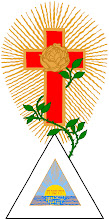




 Inlägg


