Fama Fraternitatis - 1614

Wiewohl wir nun wohl wissen, daß es umb ein ziemliches noch nicht an dem, da wieder unserm Verlangen oder auch anderer Hoffnung mit allgemeiner Reformation divini et humani, solle genug geschehen, ist es doch nicht unbillich, daß, ehe die Sonne auffgehet, sie zuvor ein HELL oder dunkel liecht in den Himmel bringt und unter dessen etliche wenige, die sich werden angeben, zusammen tretten, unsere Fraternitet mit der Zahl und Ansehen des gewünschten und von Fr.R.C. fürgeschriebenen Philosophischen Canons, einen glücklichen Anfang machen oder ja in unserer Schätz (die uns nimmermehr aufgehen können) mit uns in Demut und Liebe genießen die Mühsamkeit dieser Welt überzuckern und in den Wunderwerken Gottes nicht also blind umbgehen.

Vi vet dock att det enligt vår åstundan och andras förväntningar efter någon tid kommer en allmän reformation av både gudomliga och mänskliga ting. Ty innan solen går upp, upplyses himlen av
MORGONRODNADENS ljus. I väntan på denna reformation församlas några få som med sitt antal skall utöka vårt brödraskap, höja dess anseende och stärka dess förhoppningar och ge de av Fr.R.C. föreskrivna Filosofiska Canons en lycklig begynnelse. I all ödmjukhet och kärlek skall dessa nytillkomna tillsammans med oss dela våra skatter, som aldrig skall förgås, och så lindra denna världens möda och inte längre vandra ovetande om kunskapen om Guds underbara verk.

Howbeit we know after a time there will now be a general reformation, both of divine and humane things, according to our desire, and the expectation of others: for it is fitting, that before the rising of the Sun, there should appear and break forth AURORA, or some clearness, or divine light in the sky; and so in the mean time some few, which shall give their names, may joyn together, thereby to increase the number and respect of our Fraternity, and make a happy and wished for beginning of our Philosophical Canons, prescribed to us by our brother R.C. and be partakers with us of our treasures (which never can fail or be wasted) in all humility, and love to be eased of this worlds labor, and not walk so blindly in the knowledge of the wonderful works of God.

Definition

Det brittiska ordenssällskapet Hermetic Order of the Golden Dawn och den tyska Frimurarlogen L'Aurore Naissante, vilket grundades i London 1888 respektive Frankfurt-am-Main 1807, delade på samma hebreiska namn – Chevrah Zerach Bequr Aur, förevisat i gyllene gult vid bloggens huvud, vilket ordagrannt kan översättas till “Stigande Gryningsljusets Sällskap”. Denna tyska Rosenkorsiska Frimurarloge i Frankfurt, vilket måste anses vara det ursprungliga modertemplet till GOLDEN DAWN, kallade sig på tyska även Loge sur Aufgehenden Morgenröthe, vilket kan översättas till “Gryende Morgonrodnadens Loge”. Detta skiljer sig åt från den engelska seden att översätta orden Bequr Aur till “Golden Dawn” eller “Gyllene Gryningen”. Med anledning av Rosenkorstraditionens tyska ursprung är en mer korrekt översättning av Bequr Aur, genom franskans L'Aurore Naissante och tyskans Aufgehenden Morgenröthe, inget annat än GRYENDE MORGONRODNADEN. Denna hänvisning till ett stigande gryningsljus, morgonrodnad eller aurora är en klar hänvisning till den allmäna reformationen omnämnt i det ovan citerade stycket från Fama Fraternitatis. Denna blogg har dock valt att behålla den försvenskade anglo-saxiska termen GYLLENE GRYNINGEN för att denna, invand som den är, lättare associeras med den Rosenkorsiska tradition som här ämnas att framställas.

Licht, Leben, Liebe

torsdag 15 april 2010

The passing of a hermetic teacher

o

Jean Dubuis

* 29/4/1919
† 6/4/2010

R.I.P.

The Western Esoteric Community has lost one of its most important and prominent teachers. With his base in Rosicrucianism and Martinism Jean Dubuis has helped many students of the occult in different forms. I have written about him or his teachings many times before on this blog and gathered some salient biographical information in my Swedish essay on Jean Dubuis, the Golden Dawn Adept.

Few people are aware of the fact that he not only was a student of the Golden Dawn tradition but that he also ran a Golden Dawn Temple in the late 1970’s. He thus was one of the earliest pioneers to reinaugurate the Golden Dawn tradition in our modern era.

Unfortunately for me I never had the opportunity to meet him. Thus I have only met him through his correspondence courses on Esotericism, Qabalah, Spagery and Alchemy. His genius is clearly evident in the legacy of written material which he has left for us. Let us uphold his memory and mission by following his directions. Let us follow his often repeated adage of “Ora et Labora”.

S∴R∴

tisdag 13 april 2010

Regarding the Formula of Invisibility

o

Lately there has been a discussion on the blogosphere and fora regarding the Invisibility Operation as contained in the R.R. et A.C. document on the Formulae of the Magic Of Light, the Ritual ”Z-2”. In this document the Invisibility Formula is attributed to the Letter Shin of the Pentagrammaton, of the Name YHShVH (Yeheshuah).

The Formulae, being categorized into five departments attributed to the five letters of the Name, are attributed to the Five Elements corresponding to the Letters, Shin being attributed to the Fifth Element or Spirit (Quintessence).

The Pentagrammaton

Now the Formulae attributed to the Letter Shin are also divided into three departments corresponding to the Mother Letters of the Hebrew Alphabet, which in turn are attributed to the Three Primary Elements of Air, Water and Fire, and that of the Three Alchemical Principles of Mercury, Salt and Sulphur.

The Formula of Invisibility is attributed to Aleph of Shin, or Air of Spirit, or even Quintessence of Spirit. This means that this Operation of Invisibility is a Formula of high spiritual significance, simply by judging the attached attributions.

Looking at the attributed Key or Trumph, Aleph is symbolized by “The Fool”, the most spiritual card of the whole of Tarot. Its occult title is that of “The Spirit of Ether”. This is also the card which is attributed to the number “0”, the symbol of Ain-Soph or Nothingness. This is the darkness that were before there was any light. A fitting image of the Formula of Invisibility (as will be seen below).

The Spirit of Ether

Now this Formula is probably on of the most derided among Adepts and armchair magicians alike. There is a story (quite popular amongst the Thelemites) of the former Golden Dawn Adept Aleister Crowley, apparently originating in Corfu Sicily, which goes like this:

A stranger was sitting in a bar in Corfu when he saw a peculiar character walking down the street, dressed up in a robe and wearing a nemyss. His right hand was holding a coloured staff, with a flower on its end, and his left forefinger was pressed to his lips. But everyone else in the street was ignoring him and pretending like he wasn’t there.

The stranger asked the barman who that strange fellow was. The barman answered: “That is Mr. Crowley, who thinks he is invisible.” The stranger being perplexed asked: “But why is everyone acting like he actually was invisible?” The barman answered: “Have you ever spoken to Mr. Crowley? It is much better to pretend that you can’t see him, or else he might read you some of his poetry.”

This charming little story reminds us of the image of the Fool pictured above. Thus some modern Adepts believe that the Invisibility Formula has no place in the minds of modern magicians. On the other hand, some Adepts believe it provides a key to unlock the gateway into the True and Invisible Rosicrucian Order, i.e. “the Secret Chiefs”. This last suggestion is thought provoking and offers interesting opportunities, if it is based upon a correct understanding of the Formula.

Aleister Crowley how he must
have appeared to the Cicilians

Most, however, regards it as a “cloaking device” or “camouflage suit” for the Aura or Sphere of Sensation. I belong to this latter category. I also believe this was the original intent of the creators of the Z-2 Formula of Invisibility. Simply speaking, I believe people will have a harder time noticing you, even if you don’t disappear physically, if you perform the Formula successfully. The so-called Rose Cross Ritual has a similar but minor effect upon the Aura.

There are situations when such ability may come handy. For example during periods of intense spiritual Work and needed isolation, when social interaction can be quite distracting. This Formula is thus not only an operation of Invisibility, but also that of silence and of protection. Therefore the analogy of camouflage is fitting. It is everywhere associated with the God-Form of Harparcrates, the Egyptian God of Silence.

Harparcrates

But then again I was thinking about the Invisibility Z-formula a couple of weeks ago when driving a whole day in the countryside. I remember being quite satisfied that I currently wasn’t doing any invisibility operations, as I obviously like drivers to see me when I’m in the middle of traffic. This is the spontaneous emotional understanding of this Forumula.

I have experience of an invisibility ritual performed in a group setting, according to the directions as set forth in the Z-2, years ago. Did it work? According to the spoken intention? Yes, I do believe so. But the down side of it is that few people can receive and hold the “Divine Darkness” (N.O.X.), the powers of Binah, etc.

Some Adepts regards the Invisibility Formula as a reversed Neophyte formula, i.e. from Light to Darkness. I agree with this analysis, at least to a certain extent. To break the invisibility “spell” you simply use the ordinary neophyte formula that takes the subject from Darkness to Light, i.e. the Admission Ceremony of the Neophyte.

However, the interesting question is: From Light to what Darkness? Is it from the “light of illumination” to the “darkness of ignorance”, from the “light of the spirit” to the “darkness of matter”? Or is it another kind of “spiritual” darkness. My hard learned experience tells me that the invisibility formula invokes a “divine darkness”, that which the Thelemites refer to as the N.O.X. The melancholic Divine Feminine, the Mighty Mother, the Tears of Binah, the Waters of Creation, etc.

The Mighty Mother Binah

At the time of the operation I wasn’t prepared for this influx of Supernal Darkness, which resulted in a really bad case of the so-called “Dark Night of the Soul” syndrome. I was completely at a loss. I lost orientation in my life. For some time I couldn’t think or imagine that I would do anything Hermetic or occult in my life again. Luckily, I was the only one who had to bear this burden in the group performing this operation. As I almost didn’t recover from it, I would think twice before I perform it again, at least in that form.

So, the Invisibility formula manipulates the aura or sphere of sensation of the individual (or the egregore in a group setting), by creating a shroud of invisibility created from the powers associated with the Qabalistic Sephirah of Binah and Egyptian God-Form of Harparcrates. It also seems that it affects people differently in relation to the operator, at least if we are to trust the different reports.

Harparcrates being suckled
by the Mighty Mother


My guess is that people with their feet in the ground and consciousness at the level of the physical senses (i.e. hylics), aren’t that affected by it. But perhaps people of a more dreamy kind, introverted characters, who pay more attention to their thoughs and fantasies (i.e. the astral), and spiritual nature, are more ‘glamored’ by any form of magic, such as the invisibility formula.

Another interesting question is the following. Why does the G∴D∴ designate the Aura as the “Sphere of sensation”? How much of the sensations that we receive for interpretation in our minds comes from the actual physical senses and how much from the sphere of sensation (or energy body, or etheric body, etc.)?

As the physical and ethereal realms are quite mixed up, as the latter realm is a subtle double of the former – the etheric forming the matrix of the physical – this is not that easy question to answer in my opinion.

S∴R∴

söndag 4 april 2010

Initiation and the Four Worlds of the Qabalah

o

There has been an interesting discussion between Adepts over at the Rosicrucian Garden regarding the initiatory structure and nature of the First and Second Orders, or the Hermetic Order of the Golden Dawn (G∴D∴) and Ordo Rosæ Rubeæ et Aureæ Crucis, in which yours truly has partaken. What follows is an edited version of my contribution to this discussion. However, an understanding of this essay requires a basic knowledge of the Hermetic Qabalah and the initiatory system of the Golden Dawn, equivalent of a Neophyte Adeptus Minor of the 5°=6°.

First off, in my book initiation through a Grade system, such as the Golden Dawn, may only occur in Assiah, the plane of humanity, at least if we limit ourselves to a pure Golden Dawn style initiation. I believe both the Ritual “Z” and Ritual “U” points to this direction. I have written at length regarding the initiatic system of the Golden Dawn before on this blog, although I have modified some of my conclusions there as will be seen below.

The Grades of the Golden Dawn
as attributed to the 10 Sephiroth


Some consider the Outer Order to be associated with Assiah, while the Second Order is believed to be at the level of Yetzriah. Proving this model they use the often-quoted passage found in Israel Regardie’s books, referring to “the Four Grades of the First Order, which in one sense, quitteth not Malkuth, being the Grades of the Four Lowest Sephiroth of Malkuth in Assiah.” This quote is taken from the Ritual of the Portal of the Vault of the Adepti as presented by Regardie.

But it soon becomes obvious that this is a later development made by the Stella Matutina (S∴M∴), and the major reason for the S∴M∴ to revise their Portal Ritual in the first place. Looking at the version of the Portal Ritual of the Rosicrucian Order of the Alpha et Omega, or the A∴O∴ of S.L. MacGregor Mathers (which follows that of the original G∴D∴), you won’t find any references to “Outer Order not quitting Malkuth” and therefore being a “First Degree”, Portal being Yesod and a “Second Degree” and Adeptus Minor (as Tiphareth) being a “Third Degree”. This arrangement was made to better align the original G∴D∴ structure of Grades to that of Rudolf Steiner’s “Misraim Service”. I of course don’t agree with this development and consider it as foreign to the original intent of the G∴D∴. For a more in depth analysis in this matter, may I please refer the reader to my essay on Ruldolf Steiner.

So in my book the “Elemental Grades” are assigned to the Sephiroth Netzach to Malkuth inclusive, on the Three of Life in Assiah, the “Portal Grade” being attributed to the Veil of Paroketh and the Path of Samekh. Also, I don’t agree with the notion that the “Elemental Grades” are purely Elemental by nature, as they also are of a Sephirotic and Planetary nature. The full glory of the Planets are of course awakened in the Adeptus Minor Grade, but these forces are clearly also at work in the Outer Order. But I do agree that the main focus is upon the Four Elements. What I don’t agree with is that the Elemental Grades are but the sub-elements of Earth. They are not, as sub-elements doesn’t come into the work of the initiate until one reaches the Adeptus Minor Grade.

But one could of course problematize this statement from the Stella Matutina Portal Ritual, as it is somewhat ambiguous. If one looks upon the 1 x Tree of Life Model, where Malkuth corresponds to Assiah, I actually agree with it. But then again I also agree that no Grade of the Golden Dawn system of initiation, not even Ipsissimus, “quitteth Malkuth” in this respect. But if we look upon the 4 x Tree of Life Model where Assiah constitutes one entire Tree (and what Felkin-Meakin probably were referring to), I emphatically disagree with this statement.

As I already have stated, the entire “Elemental Grades not quitting Malkuth” idea stems from the fact that Robert Felkin and Neville Meakin needed to transform or translate the G∴D∴ initiatory system into the Freemasonic Three Degrees model (Apprentice to Master Mason), to fit it with Steiner’s system of 10 Degrees in his reformed Misraim Rite. I.e. Zelator to Philosopus being the “First Degree”, Portal the “Second” and Adeptus Minor the “Third Degree”, and thus Adeptus Major the “Fourth”, Exemptus the “Fifth”, and so forth.

The Degrees of the Misraim Service
as attributed to the Tree of Life

If one accepts the Elemental Grades being only Malkuth, one must also accept the Portal being Yesod. I don’t agree with either designation. The Portal isn’t associated with any particular Sephirah. It is properly speaking associated with the 5 Paths (that is the original name designated this ceremony) associated with Paroketh, and in particular the Path of Samekh, the archer rendering the Veil asunder. Thus the Ceremony of the 5 Paths more represent a dynamic force compared to the static Sephirothic Elemental Grades.

But one could choose to focus on the part of the quoted sentence ”...in a sense...quitted not, etc.” One could then of course see this as referring to the One Tree Model of the Universe. But with this the Portal and Adeptus Minor would find itself in Yetzirah. I disagree with this proposition, as I believe that all initiation (regardless of model, system or rite) only may occur in Assiah (the world of action and of differentiation) and thus in the 10 Sephirothic Grades corresponding to the Tree of Life in Assiah.

But if we look upon the 4 x Tree of Life model, corresponding to the four Qabalistic worlds, do we really need “initiation” at the level of Yetzirah at all? On the level of Assiah, yes of course, but of Yetzirah? I mean, Qabalistically speaking (primarily looking from the angle of Isaac Luria and the prophet Nathan of Gaza, and that of the Golden Dawn) the world of Assiah is intimately related to the Qlippoth. It is in a fallen state, only the Supernals of Assiah (i.e. Neshemah) being protected from the Red Dragon with 8 heads by the aid of the Flaming Sword.

The Red Dragon upon the Tree of Life in Assiah

In my book hermetic initiation concerns the “alchemy” of separating the fine from the gross, i.e. the divine sparks from the shells. If we speak of the prime world of Yetzirah, the world of the Angels (and of our Holy Guardian Angel), access to this exalted plane is hindered only because of the imbalances and impurities within our Assiatic bodies, i.e. the Guph, Nephesh, and Ruah (physical, etheric, and astral). Thus initiation is all about equilibration and aligning of our physical and subtle bodies, at the level of Assiah.

But again I must emphasise that it is hard to neglect the fact that this entire concept and quoted sentence actually occurred in a revised version of the Portal Grade Ceremony after Neville Meakin had met Rudolf Steiner in Germany and Robert Felkin accepting the latter as the true “Secret Chief”. Thus do I see it as a different (if not foreign) model forced upon the G∴D∴ structure. Thus do I reject the proposition that the Adeptus Minor Grade is corresponding to the Master Mason Degree, however “esoteric” form it may have taken in Steiner’s mind. I am convinced that the Blue Lodge system of Freemasonry (also referred to as “Craft Degrees”) is the equivalent of the Neophyte Grade of the G∴D∴. For a somewhat deeper analysis on this relationship between Grades and Degrees, may I refer the reader to my essay on the Golden Dawn and Freemasonry.

So these later Qabalistic interpretations of this Felkin-Meakin invention, construed in the minds of modern Adepts, looks to me more as being rationalizations to Golden Dawn-ize this forced upon model. I also believe that we all have a hard time of letting go of this concept because of it being the only version of the Portal Grade that have been known to us for so many years.

Arrangement of the Temple in the Neophyte Grade

But then there is of course the reference in the Ritual Z-1 (from which the image above is taken):
The Temple, as arranged in the Neophyte Grade of the Order of the Golden Dawn in the Outer, is placed looking towards the YH of YHVH in Malkuth in Assiah. [...] Like the other Sephiroth, Malkuth hath also its subsidiary Sephiroth and Paths. Of these Ten Sephiroth, the Temple as arranged in the Neophyte Grade, includeth only the four lower Sephiroth in the Tree of Life, viz: Malkuth, Yesod, Hod, and Netzach, and the Outer side of Paroketh, the Veil.
One may perhaps see this as a confirmation of the Felkin-Meakin deviation. But notice that is says “as arranged in the Neophyte Grade”. Now in the original G∴D∴ (and later A∴O∴) version of the Portal Ceremony the diagram of the Paths and Grades are shown, contrary to the later S∴M∴ version. Here it is said:
You will further note that the First Order includes: Malkuth, answering to Neophyte and Zelator, and the element of earth. Yesod to Theoricus and air. Hod to Practicus and water. And Netzach to Philosophus and fire.
Note that it actually does say: “Malkuth, answering to Neophyte and Zelator”.

Paths and Grades

So it’s easy to see why the Neophyte Hall only concerns the Malkuth of Assiah as it clearly is linked to the Grade of Zelator (and of Earth) where the initiate yet again meets this Sephira anew, but now in its entire (including the 6 subsequent Sephiroth beyond the Veil). Seen in this light it is understandably why this reference was removed from the S∴M∴ version of the Portal Ritual, as Felkin and Meakin gave a totally new interpretation of the Elemental Grades as instead representing each Sephirah present before the Veil in the Hall of Neophytes. This latter concept is a deviation.

Furthermore, the Portal Ceremony and 5°=6° should be regarded as two parts of a greater advancement ceremony into the Inner Order, the Portal Ceremony being the equivalent of the “Path Ceremonies” of the Elemental Grades of the Outer Order.

In the A∴O∴ (and G∴D∴) version the Portal Ceremony is clearly a part of the Second Order, the culmination of the Elemental Grades into a synthesis only hinted at. But in the S∴M∴ a first part were added (i.e. the ceremony became splintered into two) where more emphasis were laid on the union of the Four Elements and culmination of the Outer Order, while the second part concerned the actual entering into the Second Order or rendering of the Veil. So in the S∴M∴ the Portal is a “Grade” standing somewhere in the middle between the First and Second Orders, being neither or both. This is even more emphasised with the use of the “Three Degrees” model, attributing the Portal Grade to Yesod, in between Tiphareth (Second Order) and Malkuth (First Order).

This “in the middle position” between the First and Second Orders is also hinted at in the G∴D∴ and A∴O∴, as the advancement ritual introduces the initiate into the Second Order while at the same time retaining the Grade title of Philosophus for the initiate. Thus the Portal cannot be regarded as being a Grade in its own right in its original intent, but more properly being a “Senior Philosophus” level. This is contrary to the S∴M∴ where the Portal is given its own degree status, referred to as the “Second Degree”.

My personal position in this respect is somewhere in between the G∴D∴/A∴O∴ and S∴M∴ interpretations. I regard the Portal Ritual as raising the Philosophus into a Senior Philosophus level, completing the Outer Order process with the balancing out of the Four Elements with the introduction of the Fifth, and making him or her formally a Second Order member; both versions of the Ritual grants the Philosophus the right of being a Hierophant of the Temple, a Office properly belonging to a Second Order member. Thus I do regard it as a preliminary “path” ceremony of the advancement into Adeptus Minor, attributed to the Path of Ayin, Samekh, and Nun. But I also regard it as the ceremony which facilitates the union or synthesis of the Four Outer Order Elements activated in the Sphere of Sensation of the initiate. As I said, this is already hinted at in the original G∴D∴ and A∴O∴ version.

But this emphasis on the Four Elements by the Fifth, or Tablet of Union, also attributes it to the Adeptus Minor formula, in my opinion, Tiphareth being attributed to the Fifth Element. Furthermore the consecration ceremony of the Vault of the Adepti also concerns the invocation of the Four Elements by the guiding Fifth Element, the Tablet of Union having a prominent place upon the Door of the Vault. So in this respect even the invocation of the Elements echoes the Adeptus Minor Grade, even though the Philosophus rehearses his or her Elemental process in the Outer Order.
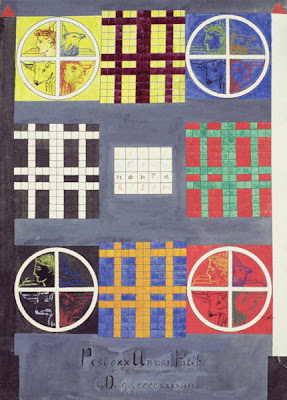
The Door of the Vault of the Adepti

But I must admit that I like the emphasis on the Outer Order Grades in the S∴M∴ Ritual. This means that I don’t discard or disregard the S∴M∴ (Felkin-Meakin) version of the Portal Ceremony in its entire. There are some good innovations, some really good even. Besides the already mentioned rehearsal of the Outer Order Elemental Grades in the initial part of the admission, we also have the use of a curtain and the Rending of the Veil, as well as the alchemical emphasis on the Officers, etc. Some of the diagrams introduced by Meakin and Felkin also have their value. What I am opposing is the Three Degrees Model inherent in this version.

I believe it is more constructive to use a composite Tree of Life model in Assiah, i.e. Malkuth representing Assiah of Assiah, Chesed to Yesod being Yetzirah of Assiah, etc., involving the different souls of the Qabalah. But as this may be confusing when we talk about man I personally prefer to use only the names and designations of the Qabalistic Souls when it comes to attributing the Three Orders of the Golden Dawn and discussion regarding the microcosm of Assiah. As the Souls in my book also correspond with the “sub-worlds” I have been referring to, this may be somewhat of a uniting principle between the seeming paradox of initiation taking place in Assiah as well as representing an ascent along the Planes and Worlds.

Thus, in the Outer Order the Grade of Zelator (Malkuth) mainly concerns (a) the physical body, or the “Guph”, of the initiate, while the Grade of Theoricus (Yesod) reaches (b) the etheric body, or the “Nephesh”, while the Grades of Practicus (Hod) and Philosophus (Netzach), as well as Lord or Lady of the Portals or Senior Philosophus (Paroketh), concerns (c) the lower astral, or the lower “Ruach”. The Adepti Grades of the Second Order concerns (d) the higher aspect of the astral body, or the higher “Ruach”; Adeptus Minor to Tiphareth, Adeptus Major to Geburah and Adeptus Exemptus to Chesed. This makes the Third Order concerned with the exalted levels of the mental and causal planes of the microcosm, as represented by the Supernals, or the “Neshamah”. Here (e) the “Neshemah” proper (Binah) and “Chiah” (Chokmah) represents the Briatic or mental body, at the level of Magister Templi and Magus respectively, while (f) the “Yechidah” (Kether) involves the Atziluthic level of Assiah or causal body, the end result of Inner Alchemy being that of Divine or Cosmic Consciousness at the level of Ipsissimus.

So what I am advocating is a 4 x 4 model, i.e. to divide each of the Four Qabalistic Worlds into four sub-worlds each, making a total of 16 levels. What we commonly refer to as ”physical”, “etheric”, “astral”, “mental” and “causal” are parts of the lowest primary worlds, i.e. Assiah, and may be attributed to the four sub-worlds (“ether” composing the lowest aspect of Yetzirah of Assiah). I believe the Ritual “U” (Microcosm) points into this direction, as it clearly assigns the Qabalistic Souls to Assiah, the Souls of Qabalah being the microcosmic equivalent of the macrocosmic sub-worlds.

So for all practical purposes I’m trying to limit the amount of the total Sephiroth to 40. However, it has been suggested to me that each sub-grade of the Adepti-grades should be assigned to individual Sephiroth. Although I don’t see any real practical worth in this kind of arrangement, from a purely theoretical consideration I do agree that one could see the Zelator Adeptus Minor Grade (Z.A.M.) as being “Malkuth of Tipharet”, etc.

Here it is wise to ask oneself the question why MacGregor Mathers created the sub-grades of the Adeptus Minor Grade in the first place. My answer to this is that I believe he did this so that the Adept him- or herself could thoroughly investigate the Elements (and Elemental Grades) he or she had been introduced to while in the Outer Order. The cycle of initiations as represented by the Outer Order is consummated in the Neophyte Adeptus Minor (N.A.M.) and restarted yet again at the level of Zelator Adeptus Minor (Z.A.M.), to make a further in depth personal study without the aid of the Hierophant.

It’s like with the philosophy of alchemy. You perform the operation again and again, and yet again and...., etc., until you have successfully purified the matter. Thus I believe this process likewise is yet again repeated on the level of Adeptus Major, which thus also should have its set of subsidiary Grades, and yet again repeated on the level of Adeptus Exemptus. But each cycle of operations takes the initiate into a yet higher arc or purer form of sublimation, like in a spiral movement, until the Adept traverses the Abyss.

Thus in my opinion initiation (regardless of level or Order) primarily works upon the Elemental nature of man (Assiah), the Materia Prima. Though the Planetary and Zodiacal nature is also involved by the nature of correspondence to the Elements.

We already know that Mathers made the Adeptus Minor study the Neophyte Grade at the level of Zelator Adeptus Minor (Z.A.M.), the Zelator Grade at the level of Theoricus Adeptus Minor (Th.A.M.), and the Theoricus at Practicus Adeptus Minor (P.A.M.). Why he didn’t synch the study of the Outer Order Grades with the corresponding sub-grades of Adeptus Minor I cannot surmise. Still he did have the Adept study the Elemental Grades in detail through the sub-grades. Personally I believe that the Elemental Grades should be rearranged to be studied in synch with the corresponding sub-grades, i.e. Neophyte at the level of N.A.M., Zelator at the level of Z.A.M., Theoricus at Th.A.M., etc.

Finally, there is also the composite (or extended) Tree scheme to consider, such as described in Z’ev ben Shimon Halevi’s Kabbalah: Tradition of hidden knowledge, also referred to as ”The Jacob’s Ladder” of the Spanish Toledano School, where Tiphareth of Assiah interlocks with Malkuth of Yetzirah, and the Tiphareth of Yetzirah interlocks with Malkuth of Briah, etc. In this model the Kether of Assiah interlocks with the Tiphareth of Yetzirah and Malkuth of Briah (see diagram at far right).

I must concede that this is a very neat system. And looking at it I can see how it opens up to interesting interpretations. But does this have any longer history in the Hermetic Qabalah of the Golden Dawn? If we limit ourselves to a strict Golden Dawn paradigm we will find that it explains a system which goes against this “Jacobs Ladder” system, as documents such as the Ritual “P” clearly demonstrates, i.e. that Malkuth of Yetzirah transforms (through a time glass cone model) into the Kether of Assiah, etc. This may be due to the fact that the Qabalah of the Golden Dawn has its firm roots in the Eastern European School, in particular with the Polish Sabbatian School of Jacob Frank.

S∴R∴

måndag 15 mars 2010

En försoningens tid är (väl)kommen

o

Idag läste jag en intressant och välskriven blogg författad av Tommy Westlund, grundaren av Sodalitas Rosae+Crucis et Solis Alati (S.R.C. & S.S.A.) och en av grundarna till Alkemiska Akademin. I denna blogg kommenterade han James Camerons nyaste alster Avatar, en film som jag ännu inte har haft förmånen att se. Jag har förstått att många esoteriker har tagit denna film till sina hjärtan med anledning av dess påstådda andliga innehåll. I detta science fiction epos kunde Tommy uttolka ett budskap som talade för försoning och enhet mellan olika splittrade smågrupper för att samla kraft mot det rådande etablissemanget för ett nytt andligt paradigmskifte. Han gjorde en parallell till det rådande tillståndet inom det esoteriska samfundet, något som jag själv betecknar som ”Rosornas Krig”, och manade till samförstånd. Låt mig citera det väsentliga i Tommys budskap:
På samma sätt är det i Stockholm, i Sverige och vidare ut över jorden i andligt praktiserande grupper. Alla vill se sig som kungar och drottningar i sina egna små riken men de är alla för små för att ett paradigmskifte mot en helare värld ska kunna infinna sig. Och när alla dessa småkungligheter sätter sig själva och sin gruppering på en piedestal, eventuellt blandat med en upplevelse av misslyckande och ensamhet då gruppen/läran ej tilltalar en större skara människor, så föds avundsjuka och illvilja även mot dem som jobbar för samma sak. Så vad kan vi göra? Ja, det är enkelt, men ändå för människan så svårt. Vi måste lämna våra sårade egon, misshandlade av eoners oförätter och övergrepp och gå samman och känna våra hjärtan läkas när vi tillsammans tjänar skapelsen. I mötet med varandra kommer tron att det vi gör har någon betydelse och med tron kommer hoppet och så det största av allt – kärleken. De olika samhällen i Avatarfilmen går samman och enhetens kraft kan som sagt uträtta mirakel.

Husalkemisten sänder härmed ett upprop till vänner och ovänner, alla ni som med era hjärtan i hand söker heliggöra vår skapelse, kom låt oss verka tillsammans!
Jag välkomnar dessa visdomsord från Tommy. Jag instämmer också till fullo med hans inlaga och de som har följt den här bloggen kanske minns att jag skrev något i samma anda för snart ett år sedan. Här sade jag bland annat att vad som sannerligen krävs är:
...en anda av förlåtelse; i sann kristen agape. Såsom vi har förhoppning att ni skall förlåta oss, skall vi förlåta er. I en anda av samförstånd och kärlek skall Osiris sargade kropp av Isis åter förenas till ett, inte nödvändigtvis i det fysiska utan snarare till anden. Vi måste låta allt som har varit höra det förgångna till. Liksom den föregående avspjälkningsprocessen för drygt hundra år sedan bidrog till en positiv eller kreativ utveckling av Gyllene Gryningens tradition så är jag säker på att vi även idag kommer att föra denna ännu vidare och längre, tillsammans och var för sig. Även om vi har olika synsätt i hur denna reformation skall tillämpas i detalj är vi fortfarande barn av samma 111 strömning. Förutsättningen för denna gynsamma utveckling i Sverige är dock ömsesidig respekt och ett erkännade av varandras rätt att tolka vår traditions öde utifrån våra respektive unika utgångspunkter. Inte minst måste vi odla detta samförstånd av hänsyn till våra respektive medlemmar och till alla som söker sig till våra respektive Tempels portar.
Under det senaste året har jag känt i egregoren och strömningen att en läkande kraft allt starkare har fått verka allt mer obehindrat. Jag kanske endast inbillar mig eller har blivit offer för sentimentalt önskedrömmande. Men jag hoppas verkligen inte det och Tommys inlägg verkar uttrycka en ärlig vilja till försoning. Frågan är nu vilket nästa steg är i denna försoningsprocess i vårt eget avlånga land? Kanske kommer något att inträffa tills närmaste Kristihimmelsfärds-helg? Den som lever och hoppas får se.

S∴R∴

tisdag 9 mars 2010

The Freemasonic origins of the Golden Dawn

o

Freemasonry forms an important part of the Golden Dawn tradition. The founders, Dr. William Wynn Westcott, Dr. William Robert Woodman and Samuel Liddell MacGregor Mathers, where all high ranking Master Freemasons. They were all also initiated into the Holy Royal Arch and belonged to several other Freemasonic Rites. They were also high ranking members of the freemasonic research lodge or Rosicrucian organisation called Societas Rosicruciana in Anglia, or S.R.I.A. for short.

W.W. Westcott dressed up as the Supreme Magus of the S.R.I.A.

Their predecessors Kenneth MacKenzie (who wrote the Royal Masonic Cyclopedia), Fredrick Hockey and Adolphus F.A. Woodford, all had the same firm freemasonic foundation. And each and everyone of these English gentlemen somehow connected to the mysterious Cypher Mss. of the Golden Dawn. Therefore it is not strange that there is lots of evidence of freemasonic origins seen in the Golden Dawn tradition and its symbolism.

Looks familar? Actually this gentleman is not happy
because he
’s the Hierophant of a Golden Dawn Temple
but instead
the First Principal of a Royal Arch Lodge

The ritual structure of each Grade follows exactly the one found in freemasonic lodges. Each Grade has its opening and closing, and admission or advancement ceremony in between. Even the traditional staff of seven officers has its direct equivalence in traditional Blue Lodge or Craft Masonry. This has all been clearly analysed by the Swedish scholar on esotericism and freemasonry, Henrik Bogdan, in his doctoral thesis From Darkness to Light: Western Esoteric Rituals of Initiation.

Sceptre heads of the three Principals of the Royal Arch

Although the majority of the Grade Ceremonies of the Golden Dawn are quite distinct as to the actual contents from all known freemasonic degrees, its Neophyte Grade still bears very strong marks and obvious similarities to the First Degree of Craft Freemasonry. It clearly shares a theme with the Apprentice Degree, the journey from darkness to light. In the consequent binding with the rope, hoodwinking, swearing of an obligation (with dire consequences if breached), the circumambulations performed, the threatening at sword point, the symbolic drawing of blood, etc., you will see a striking congruence here.

The three Principals of the Royal Arch armed with their Sceptres

Then there is the symbolism of the Neophyte Hall itself; the double cubical altar, the two Pillars – as in freemasonry often in the Golden Dawn referred to as Yachin and Boaz – the Dais with the Chiefs of the Temple, the preferred black and white tiled floor, the Quarters (points of the compass), etc. Considering this symbolism you will find that it all has freemasonic origin. Furthermore, you will find all of this symbolism summarized in the Trestle Boards of freemasonry. The Neophyte Hall of the Golden Dawn may bee seen as a three-dimensional “trestle board”, i.e. a place where the freemasonic symbolism takes a new and vivid life.

A Royal Arch Lodge

In short, I feel compelled to conclude that if freemasonry may be likened to a beautiful tapestry, then the Golden Dawn is what’s actually behind the Veil of the Sanctuary when it is finally rendered.

When you look beyond the three Craft Degrees of Entered Apprentice, Fellow Craft and Master Mason, such as the Royal Arch, the Scottish Rite, the Swedenborgian Rite, Egyptian Freemasonry, the S.R.I.A., etc., you will find even more evidence of the cross-polonisation between the Golden Dawn and freemasonry. The Grade system is almost directly taken from the S.R.I.A., or rather its predecessor of the Gold und Rosenkreutz Orden, which also at the time of its existence regarded itself to be a high degree system of freemasonry. The structure of a First, Second and Third Order, and the title of Chief, Second and Third Adepts is directly borrowed from the S.R.I.A., as is also the prototype for the Vault of the Adepti.

A Royal Arch double-cubical altar

The use of Greek names for the Officers, such as Hierophant, Hegemon, Hiereus, etc., is taken from the Egyptian Freemasonic Rite of Misraïm. Another example is the robes, or ceremonial cloaks, and wand designs use by these said Officers, which are taken from the Royal Arch and to some extent from the S.R.I.A, although modified somewhat when it comes to colours, even though they are quite similar also in this respect. And this is where we will linger for a moment.

The Sceptre of the Supreme Magus of the S.R.I.A.

If you watch the Sceptre of the Supreme Magus, as held in the hands of W.W. Westcott in the previous black and white photograph, you will notice the awfully recognizable design of it. It may best be described as a cross-over between the Lotus Wand and Fire Wand of the Golden Dawn tradition. Somehow this sceptre from the S.R.I.A. became the model for these two wands of the Golden Dawn, to be vielded by the Lesser Adept.

The Lotus Wand of David Edwards
of the Order of the Cubic Stone


Furthermore, looking at the pictures taken from Royal Arch Freemasonry you will notice a striking similarity between two of these pictured sceptres and the ones used by the Hierophant and the Hegemon. These three peculiar designs belongs to the so-called three “principals” of the Royal Arch, the Officers or Chiefs jointly leading the Royal Arch Lodge. The crown-headed sceptre is associated with the First Principal, Zerubbabel or Prince of Jerusalem, dressed in red. The mithre-headed sceptre is associated with the Third Principal, Joshua or High Priest, donned in light blue. Lastly the Second Principal, Haggai or the Prophet, is given the sceptre headed by the all seeing eye, attired in a dark violet.

The Fire Wand of William Butler Yeats

While the crown-headed sceptre of Zerubbabel found its way into to the hands of the red cloaked Hierophant, who governs the Hall of the Neophytes with his Sceptre of Power, and as the mitre-headed sceptre of Joshua were seized by the white robed Hegemon, what then became of the sceptre of the all-seeing eye of Haggai? I believe the Second Principal is to be associated with the Hiereus (the second in command between the Hierophant and Hegemon) dressed in a black mantle, who now has been armed with the Sword to bar off any unwanted forces by the power of Geburah or Severity.

The Lamen of the Sentinel

This all seeing eye of God has its ancient origin in the Eye of Horus, and as a matter of fact the god-form of Horus is traditionally associated with the office of Hiereus. The symbol of the Eye itself found its way into the Sentinel’s Lamen, who in a way assists the Hiereus in keeping out any unwanted company from the Hall; he is the equivalent of the freemasonic Tyler.

The Sceptre of the First Principal of the Royal Arch

So it seems that the Holy Royal Arch forms a particular important source or inspiration for the Golden Dawn tradition, above all other freemasonic rites. This is also evidenced in the important side lecture written by S.L. MacGregor Mathers on the Twelve Signs and the Twelve Tribes of Israel, which is based upon the twelve banners of Royal Arch Freemasonry.

The Sceptre of the Third Principal

So it has been proven beyond any doubt that freemasonry and its symbolism makes an important part of the Temple symbolism of the Golden Dawn. When the Hermetic Order of the Golden Dawn was formed in 1888 this connection wasn’t any where near a foreign concept as it is today, when many are trying their very best to separate them two apart. I would dare to say that the Golden Dawn was created within a freemasonic context considering the founding fathers of this tradition and the “up to your face” evidence contained in the symbolism of the Hall of Neophytes. Thus parts of the lineage of the Golden Dawn lies in freemasonic bodies such as the Royal Arch and the S.R.I.A.

Hierophant’s Sceptre
as drawn by
George Pollexfen

This connection between freemasonry and Rosicrucianism was even more intimate in 1777 as the Gold und Rosenkreutz Orden considered itself to be a direct extension of the Craft Degrees; to enter the Gold und Rosenkreutz you had to be a Master Mason. The Gold und Rosenkreutz considered freemasonry as an outer court to its own Order, and claimed that rosicrucians originally created freemasonry for this purpose in the 15th Century. This freemasonic requirement for membership was also the case with the S.R.I.A.

Hegemon’s Sceptre
as drawn by George Pollexfen

As the 1777 general reformation of the Gold und Rosenkreutz merged freemasonry with Rosicrucianism, the 1888 general reformation of the Hermetic Order of the Golden Dawn made them independent from each other, as now women were allowed to become initiates in the same fashion as in Egyptian Freemasonry. In my opinion the Neophyte Grade were added to the old Rosicrucian Grade system, which originally started at the level of Zelator or Juniorus, to compensate for the lack of the freemasonic degrees. As before freemasonic initiation into the Craft Degrees served as a preparation for admission into Zelator or Juniorus, now the Neophyte Grade served the same purpose. And remember the striking similarities pointed out between the Neophyte Grade, its symbolism of both ritual props and ceremony, and the First Degree of Entered Apprentice. This is clearly no coincidence.

S∴R∴
måndag 1 mars 2010

The Golden Dawn and self-initiation

o

The concept of self-initiation (abbreviated as “SI”) is a relatively new phenomenon in the Golden Dawn community. However, this has not always been the case amongst other organizations. The biggest “rosicrucian” organizations of them all, the Rosicrucian Order, A.M.O.R.C., has used self-initiation as an integral part of their preparatory work at the level of “Atrium” since the 1920’s, rituals who are supposed to be performed at the “home sanctum” of the individual member. But in the world of the Golden Dawn this has for almost as long a time been a fundamentally foreign idea.

In the early 20th Century when the Golden Dawn flourished in different avenues, such as the Stella Matutina, the Alpha et Omega and Fellowship of the Rosy Cross, the concept of Temple initiation in the Outer Order was part and parcel of the hallmarks of the Golden Dawn tradition. In this respect the Golden Dawn was quite freemasonic in its outlook on initiation and lineage.

This attitude was soon to be changed however since most of these Temples closed their activities in the 1940’s (Alpha et Omega) and 1970’s (Stella Matutina). Israel Regardie, himself an initiate of the Stella Matutina in the 1930’s, introduced the concept of self-initiation in the Golden Dawn tradition already in his scholarly introduction to The Golden Dawn: The Original Account of the Teachings, Rites & Ceremonies of the Hermetic Order of the Golden Dawn, written in 1937. But it was first heard of being practiced through the confessions of the two founders of the Order of the Cubic Stone, a Crowleyan Golden Dawn hybrid organization which saw its heyday in the 1960’s. Both of the founders, David Edwards and Robert Turner, published journals containing their self-initiatory workings through the Outer Order and into the 5°=6° Grade of Adeptus Minor.

Israel Regardie was the single individual who not only introduced the idea but also popularized the concept of self-initiation in the Golden Dawn community. This idea is expressed in both his editions of the Golden Dawn curriculum, the aforementioned The Golden Dawn, originally published in four volumes during the late 1930’s and early 1940’s, and the latter The Complete Golden Dawn System of Magic, published in 1984. Especially the latter title is a clear proponent of this idea and expounds upon it further.

It seems as if Regardie proposed the idea that his own development of the so-called “Opening by Watch-Tower” ritual was to be substituted for the Outer Order Elemental Grades of the Golden Dawn. It has been suggested that in his opinion this highly potent ritual resumed the entire Outer Order process and therefore could be used as a self-initiation ritual into the Golden Dawn. He also used this formula on his closest student, Cris Monnastre, who would perform this ritual hundreds of times until he found her eligible for advancement into the Adeptus Minor or 5°=6°.

However, it has also been suggested that Regardie didn’t believe it was possible to self-initiate into the 5°=6°. Thus in time for her initiation in 1982 into the Adeptus Minor level Regardie himself initiated her into the 5°=6°, in a fully consecrated Vault of the Adepti. This event also sparked the resurrection of the Hermetic Order of the Golden Dawn in America in the early 1980’s.

Since then this idea has been thoroughly ingrained into the modern mind of the Golden Dawn student, that it is possible to self-initiate through the Outer Order grade system, but not into the Adeptus Minor. But I ask if this is a fact or simply a token of wishful thinking, or simply has become necessary only because of the fact that there weren’t any known initiating Temples to be found anywhere in the world at the turn of the late 1970’s?

Personally I have a firm belief when it comes to the concept of self-initiation and I have written elsewhere on this blog regarding the pros and cons of SI (as well as of astral initiation). But I believe it’s time for me to develop this thinking a little bit further. As it seems, the truth is seldom in black and white.

First of all, I don’t believe it’s possible to become a Golden Dawn initiate simply by the aid of self-initiation. The Golden Dawn tradition sets its own criteria of who is considered to be an initiate and who is not. It plainly says that you need an initiator to become fully initiated. Compare with Freemasonry. You will never become a Freemason just by performing the Blue Lodge grades solo, by yourself. Why anyone would even consider calling himself a Golden Dawn initiate if not being initiated by a Golden Dawn Order is beyond my comprehension.

However, you may become a Golden Dawn Magician, i.e. a Ceremonial Magician who works within the Golden Dawn tradition. And there are lots of these magicians around who has never seen the insides of a Golden Dawn Temple, but still deserves my deepest respect as a fellow magician.

But one has to make a clear distinction between an initiate and a non-initiate nevertheless. The former is part of a greater egregore and current, besides having access to centuries old oral traditions and unpublished documentation, which aids him in his spiritual unfoldment, the latter has only himself to resort to and published literature. Even though it is possible to tap into the Golden Dawn current by the simple use of its ceremonies of Theurgy and symbolism, this cannot be compared to becoming a part of that current through ritual group initiation. And the current of the Golden Dawn is mighty indeed! So it’s no surprise that it spills over to non-initiate practitioners of the Golden Dawn system of Magic.

Thus in my opinion self-initiation may never become a legitimate substitution for Real Temple Initiation. But it is the second best option if you want to spiritually emulate states of consciousness which approximate that of Temple Initiation. It definitely is a much better option compared to so-called “astral initiation”, in the case of a student of the Golden Dawn lacking the ability or possibility to receive classical Temple initiation.

In both classical Temple initiation and self-initiation you basically involve three levels or planes of existance, commonly referred to as the physical, etheric and astral. These three levels are involved in all forms of Ceremonial Magic and Theurgy (or at least should be) to be successful. There is the physical movement and direct manipulation of nerve current, and then there is the energetic manipulation of the etheric double or Sphere of Sensation (aura) using the subtle energy called “prana” or “qi” in the eastern traditions, or “pneuma”, “ruach”, and “L.V.X.” in the western, and then lastly there is the emotional and spiritual (i.e. astral) impact.

In ritual magic, of which initiation plays an important part, the focus lies in the physical and energetic bodies (the Sphere of Sensation) through the transmission of magical current, but it has also a profound spiritual and emotion effect because of this current (which passes through the astral from the causal-spiritual) and especially the ritual drama which forms emotionally charged concepts or thought forms in the mind. The ritual also creates a portal into the astral realm, the particular plane or dwelling place of the force invoked. This astral realm may be reached and researched through the use of certain symbols contained in the ritual. Thus in self-initiation one has to combine ritual magic and energy manipulation with inner visionary work.

But I believe the modern approach, which has been suggested in the wake of Regardie’s publications, to solitary perform the actual initiation ceremonies directly or from his books is a bad way to approach this subject, even if Regardie himself initially suggested that the self-initiating student should visualize the entire rituals in his imagination. Even though Golden Dawn initiation rituals may be performed by fewer officers than the required per the ritual instructions, and thus become modified to suit the number of present Officers, it always must at least have the initiator present for it to be a real Temple Initiation. Thus in classical G∴D∴ (and R+C) initiation, the initiate needs the initiator (the significant “other”).

But this aside, there is a lot a solitary magician can do to approach the Golden Dawn current. The initiation rituals may be emulated without taking resort to performance to the letter as they are presented in Regardie’s books. Thus with self-initiation I would recommend a simpler approach:
  1. Invocation of the forces attributed to the Sephiroth in succession. At the level of Malkuth (attributed to the Zelator 1°=10° Grade) the self-initiate should regularly invoke Earth and the Earth Triplicity of the Zodiac, through the use of the Pentagram Ritual. At the level of Yesod (attributed to the Theoricus 2°=9° Grade) he should instead invoke Air and the Airy Triplicity of the Zodiac, as well as the Planet of Luna (and also the transcendent twin of Saturn). At the level of Hod (attributed to the Practicus 3°=8° Grade) he should now invoke Water and the Watery Triplicity of the Zodiac, as well as the Planet of Mercury (and also the transcendent twin of Jupiter). Lastly to finish off the self-initiation cycle through the Elemental Grades he should at the level of Netzach (attributed to the Philosophus 4°=7° Grade) invoke the Element of Fire and the Fiery Triplicity of the Zodiac, as well as the Planets of Venus and Mars. David John Griffin’s little gem The Ritual Magic Manual: A Complete Course in Practical Magic is a perfect primer for this kind of SI work.
  2. This is then to be combined with path-workings in a similar style to the ones presented in Dolores Ashcroft-Nowicki’s The Shining Paths, but re-written to better incorporate the symbolical journey made by the candidate through each Path of the Golden Dawn initiatory system (in where each Tarot Trump plays an essential part). Vital ritual components from the actual initiation ceremonies may (and should) be integrated with this, for example a solitary version of the openings and closings of the Grades, and some important (but simplified) movements done to emulate the ritual drama of the advancement ceremony. But the emphasis should be made on the astral vision and inner journey when it comes to the traversal through the Paths upon the Tree of Life.
  3. Furthermore, to ingrain and activate (in the Sphere of Sensation or aura) the different diagrams used throughout the rituals, the self-initiate should regularly meditate upon them. Here also the self-initiate could open and close the session as per the description of the Elemental Grade to further advance the level of working.

This combined use of ritual invocation, and meditation, as well as the type of path-working rituals as has been suggested, can create a spiritual environment which may elevate the soul to a level approximating that which is supposed to happen in a Real Temple Initiation. In rare instances it may even make someone a “Practicus” or “Adeptus Minor”, but perhaps not valid in an Order context. If you want peer recognition, traditional Temple initiation is the only way to go. But there is more to Temple initiation than mere peer recognition. But that is another story worth of its own essay.

Regarding Israel Regardie’s recommendation to use the Watchtower Ritual as a substitute for the Elemental Grades, I agree with many modern Adepts of the Golden Dawn that it is a bad recommendation. But in my opinion it is not because of the actual Elemental forces being invoked together per se but primarily because of the innate 5°=6° nature of that ritual. So properly speaking the Watchtower Ritual may be used as a self initiation ritual into the Adeptus Minor 5°=6°, in a last phase of self-initiation, more than to the Elemental Grades. Another reason for leaving that ritual for last is because of its sole emphasis on the Enochian aspect of Golden Dawn Theurgy. For the similar reasons I would also leave out any Enochian Calls through the self-initiatory process of the Outer Order, as these workings properly are introduced at the level of the Second or Inner Order.

For the Elemental Grade self-initiations I would recommend the use of the Greater Pentagram Rituals (meaning the use of the individual Pentagrams from the Supreme Ritual of the Pentagram) in the manner as these are used by the Hierophant in each opening of the Grades of Zelator 1°=10°, Theoricus 2°=9°, Practicus 3°=8°, and Philosopus 4°=7°. Even if the actual use of these Pentagrams used to be reserved for the Adepti Minori, the self-initiate must take the role as the Hierophant himself, hence he must himself perform them even if it is “beyond” his level or Grade.

For the initial Neophyte level of self-initiation I would recommend a thorough study of the Neophyte formulae of the Magic of Light, as suggested in “Ritual Z-2”, and especially under the heading of “Shin – Spiritual development”. This ritual emulates the admission ceremony of Neophyte 0°=0° and serves to be a species of “self-initiation” ritual of the Adeptus Minor to reach his Augoeides or Higher Self. Therefore it is likewise a very good ritual to perform for the purely self-initiating student. This should be combined with the regular peformance of the Lesser Invoking Ritual of the Pentagram which is especially attuned to the 0°=0° formula.

In the instance of the “Ritual Z-2” the Higher Self or Divine Genius takes the role as the initiator. This is also the attitude which must be held by the self-initiate in general. He mustn’t allow himself to relegate or debase his workings with the notion that he himself is the one doing the initiation. Therefore the very word “self-initiation” is misattributive of the goal of initiation; to facilitate the union between the ego or mundane self and the Higher Self or Divine Genius.

For the Portal of the Vault of the Adepti, the lowest level of Inner Order work, I would recommend a regular performance of the Supreme Invoking Ritual of the Pentagram, as it invokes the Element of Spirit crowning the work of the Outer Order. The self-initiate may also incorporate essential portions from the opening of the Portal of the Vault of the Adepti, such as the manifestation of the Word (Paroketh) and the use of the abbreviated “Enochian Call” used in the Stella Matutina version of the Portal Grade Ceremony. A corresponding path-working may be worked out through the Path of Samekh, the Archer, in a similar manner as with the Elemental Grades. There are also lots of highly illuminating alchemical and other diagrams contained in that ritual well worth meditating on.

I also want to stress the importance of the reintegrating process contained in the Portal of the Vault of the Adepti through the dominion of the Spirit or Akasha. Working through the Elemental Grades, the self-initiate subjects his psyche and sphere of sensation to a phase or process of disintegration, likened to the Solve stage of alchemy. In this phase each of the Elements and elementary parts of one’s make-up is isolated, analysed and purified separately. This disintegration may also be likened to a putrefaction, “blackening” or alchemical nigredo.

On the other hand, the process initiated by the influence of Elemental Spirit starts the succeeding phase which in alchemy is called Coagula, reintegration and union. This may also be likened to the stage of albedo, or “whitening”.

So it is imperative not to end the self-initiatory process at the level of Philosophus or Fire. Even if all of the Elements have become activated in the Sphere of Sensation, at the level of Philosophus, they are still being held apart there. There is also the need of infusion of Spirit or Akasha in the Sphere of Sensation to complete the alchemical process. In the original Golden Dawn Order from 1888, prior to the manifestation of the Second Order (the Rosae Rubeae et Aureae Crucis or R.R. et A.C.) in 1892, or as we know it today, equipped with the Vault of the Adepti et al, the level of Portal or Spirit was all that could be transmitted to the initiate. Initiation into the Element of Spirit was the end station of the journey. This is also the end station in the journey of the self-initiate.

Still I wish to make it perfectly clear that the mere performance of these Pentagram Rituals, path-workings and meditations on diagrams doesn’t make anyone a Golden Dawn initiate regardless of level of spiritual attainment. It may however make you an initiate of the Sephirah according to the Rosicrucian system of initiation, according to the Tree of Life, which would make the self-initiate the equivalent of that Grade held by a Golden Dawn initiate. And according to the general view held by Adepts in the Golden Dawn community, including Israel Regardie and with which I concur, the highest level a self-initiate may reach in the context of the Golden Dawn tradition is at the Veil of Paroketh.

And in the final analysis this is not so bad in my opinion. The goal is the transmutation of the base matter of the student, and both Temple initiation and self-initiation is effective tools to reach this goal of transmutation, although the latter solitary path is more arduous and hazardous, and doesn’t reach as far as compared to the former.

This doesn’t mean that it is impossible to reach Tiphareth and the Sephiroth beyond solely by self-initiation. But it is extremely difficult to pass beyond the Veil as it requires a combination of dedication, very hard work and exceptional talent, but beyond anything else the direct intervention of the Divine Grace (i.e. good “luck”). It may be compared to casting dice; you have to be a good gambler to be able to rend the Veil of Paroketh. It may be compared with the alchemists searching for the Philosopher’s Stone without access to initiation into Hermetic Alchemy; they can only receive the wisdom necessary to reach the Summum Bonum by the Grace of God (Ora et Labora). Initiation however by-passes this as the sacred knowledge has already been received and is contained within the uncorrupted traditions and the power of spiritual lineage.

A final observation, which I already hinted at in my discussion on the “Ritual Z-2”, and the last paragraph when I wrote “solely by self-initiation”. Who in the Golden Dawn cannot (or mustn’t) be a self-initiate to properly activate the current? I mean, even if you have the privilege of being a member of a Golden Dawn Temple (and there are lots of these today), going through all initiations in the traditional fashion, this won’t necessarily make you a part of a Grade spiritually speaking just like that. It takes hard work on your own to reach a supposed Grade.

Initiation literarily means “to start”, i.e. to initiate a process of unfoldment. To properly unfold the initiate he has to work with spiritual exercises and rituals by himself, under the guidance of the initiated current within the context of the egregore. I hold that, in the optimal situation, to belong to a Grade means that a process is alive and dynamic which has been initiated by the advancement ceremony and which finally ends with the initiate becoming attained of that Grade (by individual hard work), just prior to taking his next advancement.

So it boils down to the fact that there shouldn’t be any significant outer difference when one scrutinizes the actual individual work being done by the self-initiate and the regular Temple initiate; the only difference being the lack of traditional full and physical Temple initiation. Classical Temple initiation is not a jolly free ride which makes individual work reduntant. On the contrary it necessitates personal hard work to cultivate the seeds sown by the initial admission or advancement ceremony.

To summarize this discussion, there are lots of suggestions and directions in the above paragraphs for the aspiring self-initiate if he dares to look for them. An aspiring self-initiate shouldn’t worry about anyone criticizing him for using Inner Order techniques, such as the “Ritual Z-2” or the Pentagram and Hexagram Rituals, Rituals “B” and “C” respectively. As a self-initiate he is bound to use them and more advanced formulae to successfully self-initiate himself. But let him stay away from implementing the Enochian stuff, as contained in Rituals “H”, “S”, “T”, “X”, “Y-1”, and “Y-2”, into his regimen of self-initiatory discipline until he has reached the final level of Portal of the Vault of the Adepti and started to work properly with the ritual of the Opening by Watch-Tower.

The self-initiate should however try to stick to the symbology pertaining to the Grade he wishes to emulate. I.e. he shouldn’t use the Watchtower Ritual already in the Outer Order process as it incorporates specific 5°=6° Grade formulae pertaining to the Vault of the Adepti. He should wait with that until the last stage of his work. If the self-initiate wants to use the Elements in unison, may I suggest instead using the Supreme Pentagram Ritual. However, I would recommend the self-initiate saving that for the Portal of the Vault of the Adepti SI ritual.

For the 0°=0° SI ritual, I would recommend using the “Z-2”. For the Elemental Grades I would recommend using solo versions of the openings and closings, and to use important portions from each Elemental Grade (breaking them up in a similar fashion like the “Z-2”), combining this with path-workings and meditations on the diagrams contained in each ritual. I would also admonish the aspiring Golden Dawn self-initiate not to incorporate foreign (non G∴D∴) elements (such as from Crowley-Thelema) if he wants to attune to the Golden Dawn current.

I would like to close this essay with some thoughts I have had recently regarding a modern classic penned by John Michael Greer entitled Circles of Power: Ritual Magic in the Western Tradition. It has been suggested that this book and its instructions may be used for Golden Dawn self-initiation. In the pages 58-62 of this book the author covers the use of the different Openings and Closings which may be utilized for SI work, using the pentagram ritual. Greer distinguishes between three different openings and closings which he refers to as the “first”, “second” and “third” degrees.

I quite recently acquired a copy of this book by Greer so I haven’t had the chance of reading it yet in full. But reading the first two chapters of this book it really looks promising and could at last replace the old time favourite self-initiation book Modern Magick: Eleven Lessons in the High Magickal Arts by Donald Michael Kraig. Also skimming through the said pages 58-62, and some preceding them, it becomes clear that Greer adheres to the Stella Matutina model of First, Second and Third Degrees:

First Degree: Neophyte 0°=0° up to Philosophus 4°=7°, i.e. Malkuth.

Second Degree: Portal of the Vault of the Adepti, i.e. Yesod.

Third Degree: Adeptus Minor 5°=6°, i.e. Tiphareth.

This is an interesting observation and I would bet my money that Greer’s model of self-initiation more links the self-initiate to the Stella Matutina egregore and current, rather than to the currents of the original Golden Dawn and Alpha et Omega egregores. Nevertheless, it seems to be a very interesting book and I look forward to reading the rest of it. Perhaps I will return to it here on my blog and make a full review after I have finished my reading.

S∴R∴